


Woven for success: Inside homegrown brand Suta's 1200% growth story
Co-founders and sisters Sujata and Taniya Biswas of homegrown saree brand Suta spill the secret sauce and brand strategies behind the magnanimous grow.



In a world of power suits and voluminous gowns, a saree always steals the show.
Take the Cannes Films Festival, for instance. In 2002, actor Aishwarya Rai made an entrance in a horse-drawn chariot in a yellow handloom organza and created an iconic moment. Twenty-three years later, at the ongoing 78th Cannes Film Festival, the actor made headlines once again. This time, in an ivory Banarasi, at a red carpet crowded with evening gowns and cocktail dresses.
But the power and magnificence of a saree is not just limited to the red carpet.
Closer home, during the launch of their second store in Bengaluru, entrepreneurs and sisters Sujata and Taniya Biswas draped the saree like they mean business.
Sujata dressed in a gold and pink Banarasi paired with Onitsuka Tiger—resonating with Bengaluru’s startup culture and its obsession with the shoe brand, and Taniya in a bright pink mulmul, paired with leather boots—the founders of homegrown saree brand Suta are on a mission to make the saree effortless and cool—not just limited to special occasions or for the red carpet.
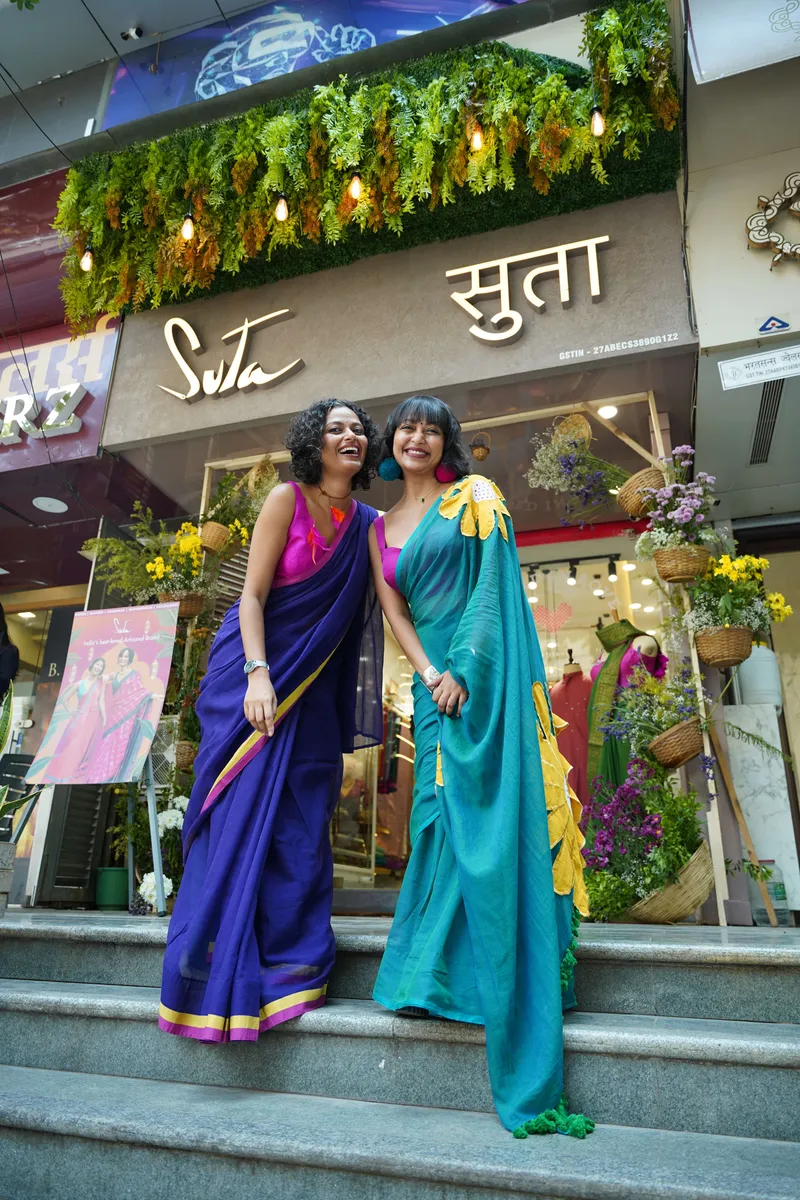
Sujata and Taniya Biswas (L-R), the founder of homegrown saree brand Suta
“One of our strategies is to make the brand look and feel like how we are—a small, homegrown and achievable brand…We don’t have models or drape artists. We drape it (a saree) ourselves and on the go, just how it should be,” the Suta sisters tell YS Life during an exclusive conversation.
Founded in 2016 with an investment of Rs 6 lakh, and a single store in Mumbai, Suta managed to grow its revenue to Rs 5.5 crore by 2019. Working with close to 50 weavers from across the country, the founders were sure to grow, but at a sustainable pace.
Fast-track to present day, Suta has churned Rs 75 crore in FY2024-25—a 1200%-plus growth, selling handwoven sarees across its website, ecommerce platforms, and 15 stores. Continuing to be bootstrapped, the brand works with a massive network of 17,000-plus artisans and weavers, and does not intend to stop anytime soon.
“Our plan for 2025 is to aggressively grow our offline presence, and open 10 more stores,” says Sujata.
Stitching success
Diving into their growth strategy, Sujata explains that keeping everything in-house was an expensive but rewarding move for the brand.
Everything behind the scenes at Suta is managed in-house today—warehouses (in Mumbai and Kolkata), digital marketing, content, design, and even product shoots. The day-to-day operations are thus “controlled and have a personal touch.” “It also allows us to correct our mistakes very fast,” Taniya adds on.
The saree business is not a cake walk. A significant player in the global textile industry, the saree market continues to be unorganised, although expected to grow to more than Rs 62,000 crore by end of FY25, according to Exportimportdata.
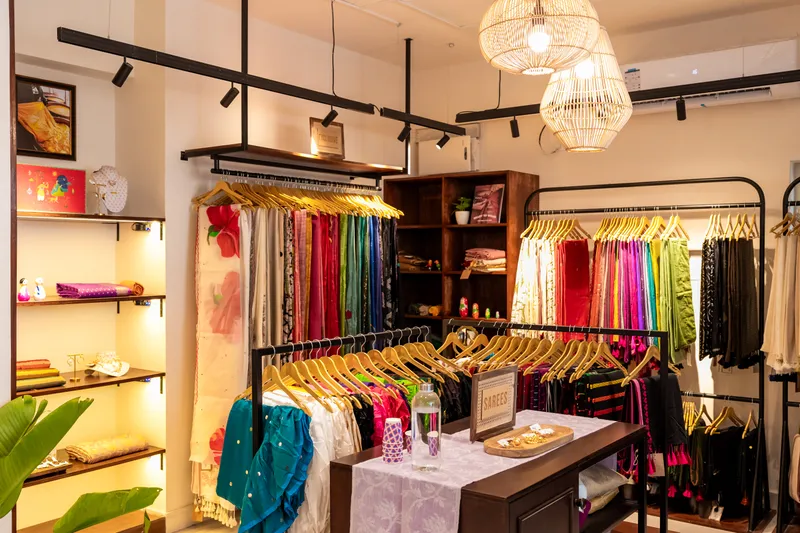
The 15th Suta store in Bengaluru's HSR Layout
In a market that is usually dominated by traditional players like Pothys, RS Brothers, Kalyan Silks, Sai Silks Kalamandir, Nalli, among others, Suta is aggressively becoming the go-to saree brand from the new and next generations.
“We do a lot of college talks and campus activations…We catch the customers very young so that they don’t grow up complaining that they don’t know how to drape a saree!” Taniya explains.
Available on popular platforms like Ajio, Myntra, and Nykaa Fashion, among others, Suta makes 15 to 20% of its revenue from ecommerce. 50% of its sales come from the official website, and another 30-35% from the offline stores.
Suta strategically places its products across various verticals too. “Online channels need to have the best-sellers and offline stores need fresh and new pieces every time a customer walks in,” the sisters say. Similarly, while a flat discount works best for online channels, bundle-discounts do the trick at the stores.
Interestingly, Su(jata) and Ta(niya) themselves play the models for Suta’s product shoots. This, instead of having models pose in their products, allows the brand to be more relatable for customers.
“Myntra recently told us that workplace sarees are working for them, so our next shoot is completely focused on workplace (wear),” Sujata reveals.
The pricing of its products showcased across channels is crucial too—products within the range of Rs 4,000 for its online website and ecommerce platforms, and pushing the more expensive and exquisite pieces to the offline stores.
In order to remain competitive and relevant across cities, Suta produces store-exclusives for each city. For instance, a Kolkata store would feature a Dhakai Jamdani, while a Bengaluru store would feature exclusive Ilkal pieces.
“These are usually crafts that are challenging to replicate. For instance, you can’t make more than five pieces of the same ikkat saree, it becomes different after that. So, it works for our physical stores, but won’t work online,” Sujata explains.
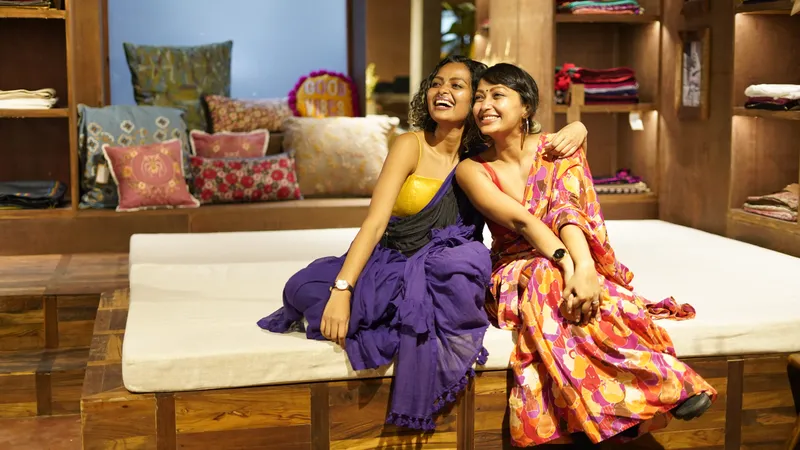
At each of its stores, Suta has placed a merchandising manager to help with production planning, based on the sale trends of that particular outlet.
Suta’s secret sauce also lies in innovation—things that are essential for a saree buyer, but usually overlooked by other players. “Nobody ever gives a saree with the falls (fabric sewn to the helm of the saree to help with draping and support) done. The notion is that if the falls is already done, it’s an old product. We took a wild call and took a risk by putting the fall in all our sarees…We know our customers will need to go and get it done…We have great material and we said we will do it for them, and the customers loved it!” says Taniya.
Similarly, known for their stylish and unique blouses, Suta provides customers with the option of making it padded, with or without sleeves, and other customised alterations—all at the click of a button. Recently, it also added the option of converting all sarees into pre-draped ones with customers having to just check on the option, at an extra cost of Rs 1,499. These changes, the sisters claim, were based on their day-to-day observations and interactions with customers.
In the business of storytelling
While the world chases trends and fast fashion, Suta relies on making business by telling a good story.
Right from the very first day, the sisters have focused on connecting with their existing and potential customers through the power of storytelling. Each Suta product has a unique name and a background fictional story or description attached to it.
“We always felt that when you have a product with a name, you’ll not throw it away…When we were kids, we never threw away the dresses or sweaters our mothers or grandmothers made, but we discarded the store-bought ones…When your blouse has a name, you will keep it and talk about it,” Sujata says.
“Customers also tend to buy products that they share their names with…A lady called Rekha bought all the Rekha sarees!” chimes in Taniya.
Suta launches two to three collections every month, of which at least one is a new saree collection. The brand holds up to five to six months of inventory at a given point of time, and in order to make the business grow faster, it now uses a mix of handloom and power loom products.

On to the next 500% growth
Imitation is the greatest form of flattery, and like most successful brands, Suta also has its copies available in the local and online marketplaces.
“Khub raag hoye (makes me very angry), but we have a legal team going after brands that exactly copy our pieces and use our pictures. But if brands are working with weavers and producing similar products, we don’t go after them…We feel together we are only building this community,” Taniya adds.
The Suta sisters are aspirational and are looking to generate close to Rs 120 crore revenue in the next financial year. With saree as their flagship product, the brand has now expanded to other womenswear (kurtas and dresses), jewellery, menswear, kidswear, and home products, and plan to further grow these verticals. Suta also plans on hiring industry experts for key positions, and make the omnichannel journey smoother.
With two brand-owned stores and 13 franchise stores operating in the FOCO (franchise-owned company-operated) model, Suta plans to further expand to retail stores and saturate the Tier-I market, while also moving to Tier-II and Tier-III cities.
“Because of people’s aspirations and disposable income, the smaller cities and towns have been performing well. We are actively looking to open stores in some promising cities, based on our online sales data, with the FOCO model,” Sujata says, adding: “We are also looking at opening the stores in malls.”
Suta is also on a retail expansion spree, and plans to launch a new store every month. Next up is its second store in Kolkata. International expansion is also in the cards through partnerships—multi-brand outlets, franchise and pop-ups.
And what about IPO, we ask.
“We are open to it, although there are no plans for the current financial year!” the sisters say.
Edited by Megha Reddy