



Inside Curefoods' strategy against quick food delivery and its bet on Krispy Kreme and other brands
As foodtech company Curefoods gears up for an IPO, it is keen to double down on doughnut chain Krispy Creme, expand its cloud-kitchen format, and scale new brands.

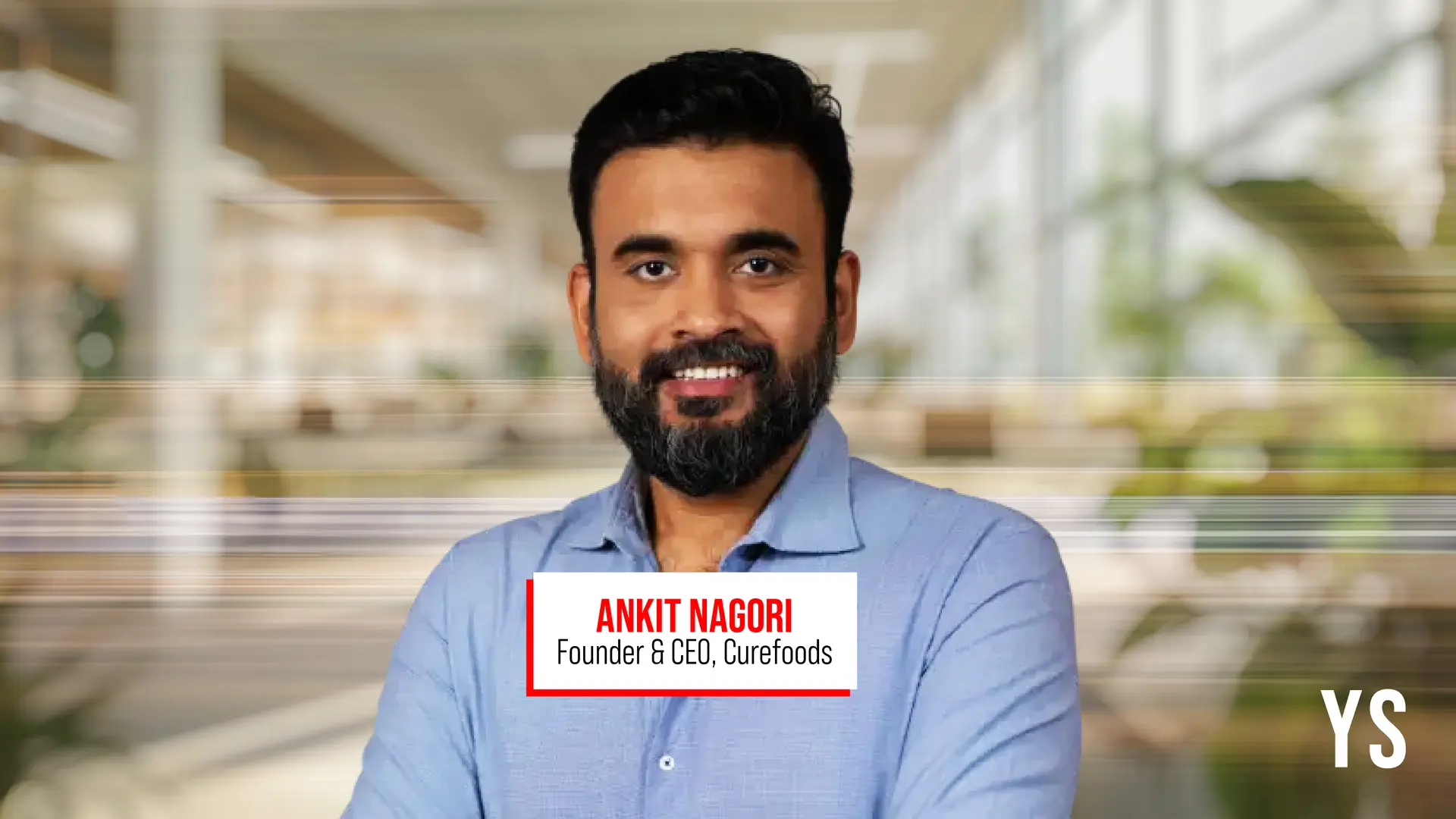

Foodtech company Curefoods, which is on its way to a public market listing, has a clear plan of action.
This includes doubling down on doughnut chain Krispy Kreme with renewed focus and expanding its cloud kitchen format for mass premium brands including Sharief Bhai Biriyani, Olio Pizza, and Enso Sourdough, especially beyond metro cities.
The Bengaluru-based company, which recently completed five years since inception, also plans to launch and scale new brands such as ice cream brand Papa Cream and burger brand Phat. It is expecting to close the financial year ending March 30, 2026 with a topline growth of 25%.
After receiving SEBI approval for an IPO in October last year, Curefoods plans to raise Rs 800 crore from public investors after the current financial year.
The house of brands manages a diverse portfolio of food brands, including Nomad Pizza, Olio Pizza, and Sharief Bhai Biryani, along with chains CakeZone and MilletExpress—through a mix of online and omnichannel play.
The cloud kitchen operator and QSR player had toyed with its own delivery channel in 2022. While it managed to scale it to 5k orders a day across five of its in-house brands, it had to shut down the service in just two years due to high delivery cost.
Amid rising competition from quick-commerce platforms, Curefoods bets on ‘specialisation’ across four distinct categories: desserts, pizza, Indian, and daily foods to tackle the challenge.
“Multi-cuisine, 10-minute delivery brands simply cannot replicate highly specialised offerings—whether it is the specific flavour profile of a Sharief Bhai Biryani, the 200 custom designs we offer through CakeZone, or the gourmet quality of a Nomad Pizza,” says Curefoods Founder and CEO Nagori, in an interview with YourStory.
Nagori believes food is inherently preference-led. Quick-commerce platforms may play in the snacking category but they cannot serve as a full replacement for discerning consumers or become a mainstream dining option, he says.
He also talks about the company’s positioning as a grab-and-go player in the coffee market and its plans to scale its packaged food business.
Edited excerpts from the interview:
YourStory [YS]: The coffee market is already crowded with both new and old players. How do you position Curefood in this space?
Ankit Nagori [AN]: We are not competing with the Blue Tokais of the world at all. We are not a speciality coffee player. We are an on-the-go coffee player; we are just trying to fit in right in the middle of unbranded coffee and speciality coffee. We are aiming to organise the unbranded, non-speciality coffee (market). There are some new operators here too, but we want to be the branded on-the-go coffee.
YS: There is growing concern over sugar intake and rising awareness about protein consumption. How do you see your portfolio amid the growing focus on healthier categories and guilt-free consumption?
AN: I think the market is smaller than most people think; it’s a very top-ten city play. Beyond these, guilt-free just means whole wheat, maybe less sugar. People are not okay with sugar-free or different sweeteners yet. Guilt-free snacking is a top-ten city and top 10-million people play, and for this we have multiple brands including EatFit (healthfood brand) , Millet Express (gluten-free brand) and HRX (a high-protein brand). These together bring in about Rs 15 crore revenue per month, but we see it as a plateauing business.
YS: What will be the strategy for Krispy Kreme’s offline operations with IPO proceeds?
AN: IPO proceeds would primarily be used to build out cloud kitchens. Krispy Kreme is our first international branding brand franchisee; it takes away the headache of us building the brand and product. So, making it a success is just largely a distribution retail play. This gives so much leverage because PMF (product market fit) is already met; the focus is on expansion. When we acquired the brand last year, it was run by some other operator for whom it was not a strategic category.
At the time, they had less than 20 stores, and now we've expanded to 100 odd stores. We are the only large operator in the world for Krispy Kreme with cloud kitchen franchising rights. So, we are looking at a hybrid model where Krispy Kreme sits inside our network of 300 plus cloud kitchens, with a pick, pack, and dispatch model.
For the retail channel, our strategy will look at wherever there is a food crowd—airports, malls, educational institutes, tech parks etc, and build a Krispy Kreme coffee and doughnut brand. It’s a doughnut brand, but we are also building a very-large-budget coffee programme on top of that.
In terms of channel diversification, already 25% of our operations are offline. In the longer term, we see at least 40% coming from offline distribution given all the expansion that will happen to Krispy Kreme and Shareef Bhai.
YS: What is your outlook and strategy behind scaling QSR operations, FMCG, and packaged foods?
AN: Quick commerce is our main lever for scaling packaged foods. However, the challenge is the sweet spot for quick commerce is strictly under Rs 100. Once a product crosses that benchmark, shoppers rarely add it to their baskets.
HRX is currently a Rs 50-crore brand, but it is in the ‘0 to 1’ journey for its FMCG products because it’s highly premium, with a price point of Rs 160. It currently contributes about 10% of total sales but I expect the beverage contribution to increase to roughly 25% over the next 5-7 years as HRX grows. Beyond protein, we are actively looking at the fibre and gut health segments.
CakeZone is a great example of a brand successfully repurposed for FMCG. In future I expect 30-35% of CakeZone's sales to come entirely from the packaged segment.
Overall, as Curefoods grows from a Rs 1,000 crore to a Rs 2,000 crore company, achieving a 5-10% revenue contribution from packaged foods (around Rs 100 crore) would be a very comfortable target, but we won’t change our core DNA. Packaged food will always be treated as an ancillary category.
YS: How is Curefoods defending its market share against the rise of quick-commerce platforms that are aggressively commoditising daily, mass-market food categories?
AN: Our core strategic defence against quick commerce is specialisation. We have structured our portfolio across four distinct categories: desserts, pizza, Indian, and daily foods. Multi-cuisine, 10-minute delivery brands simply cannot replicate highly specialised offerings—whether that is the specific flavour profile of a Sharief Bhai Biryani, the 200 custom designs we offer through CakeZone, or the gourmet quality of a Nomad Pizza.
Out of our 2,000 total menu items across all brands, only about 400 items—or 20% of our menu—fall into the ‘daily’ or evening snacking category, which includes items like rolls, chaat, idli, and samosas. It is only this 20% that competes directly with the 10-minute platforms. To defend this specific segment, our primary operational hook is leveraging Swiggy Bolt, allowing customers to order our daily items within that 10-minute window.
Ultimately, food is inherently preference-led. While 10-minute platforms have seen traction, they often rely heavily on frozen food to meet delivery times, meaning they cannot serve as a full replacement for discerning consumers. Quick commerce is playing in a very narrow sliver of the market; it will remain a channel for 10-minute snacking rather than ever becoming a mainstream dining replacement.
YS: Do you see yourself shifting gears and building out your own D2C channel? Or have you given up on that?
AN: We’ve given up on that because there is no economics there. On the daily food stack, the AOV (average order value) would be 300 rupees, with a gross margin of 50%. Add on a delivery cost of Rs 100 rupees, you are just left with Rs 50 to cover all other costs: rent, manpower, and central marketing. I just don't see how economics will work.
For platforms like Zepto, Blinkit, etc, it is all about the utilisation of their own resources (a dark store and a dedicated hyper-local fleet); it’s like 7/11 having a standalone food counter.
Food, from a first-principles perspective, requires a lot of order density. I would be very happy to be proven wrong, but I’m not able to see how it will work. Hence I’m not launching it. Otherwise, I could mount that tomorrow with 500 kitchens. If they’re (quick food delivery startups) able to crack it, they will win very big. The opportunity is big, but I don’t back myself to build it right now.
YS: How are you approaching expansion in Tier II and III cites for Enso Sourdough (a sourdough pizza brand). How is the strategy going to be different as compared to metro cities?
AN: Menu mix is the only thing you can change. You can’t change the positioning of the brand depending on the cities. But what you can do is to shape the menu. Single-topping pizzas and combos will be a much larger focus in smaller cities because they are more affordable. We’ve just introduced slices, and, in just a three-week period, it’s already 7-8% of our overall pizza sales, mainly because it’s at a Rs 99 price; so people are okay to eat less portions but they order more frequently.
Edited by Swetha Kannan