From home to panchayat: Bihar’s Seema Kumari and her journey of women’s empowerment
After her first election loss, Bihar’s Seema Kumari won and began working on education, roads, women’s empowerment and water conservation.

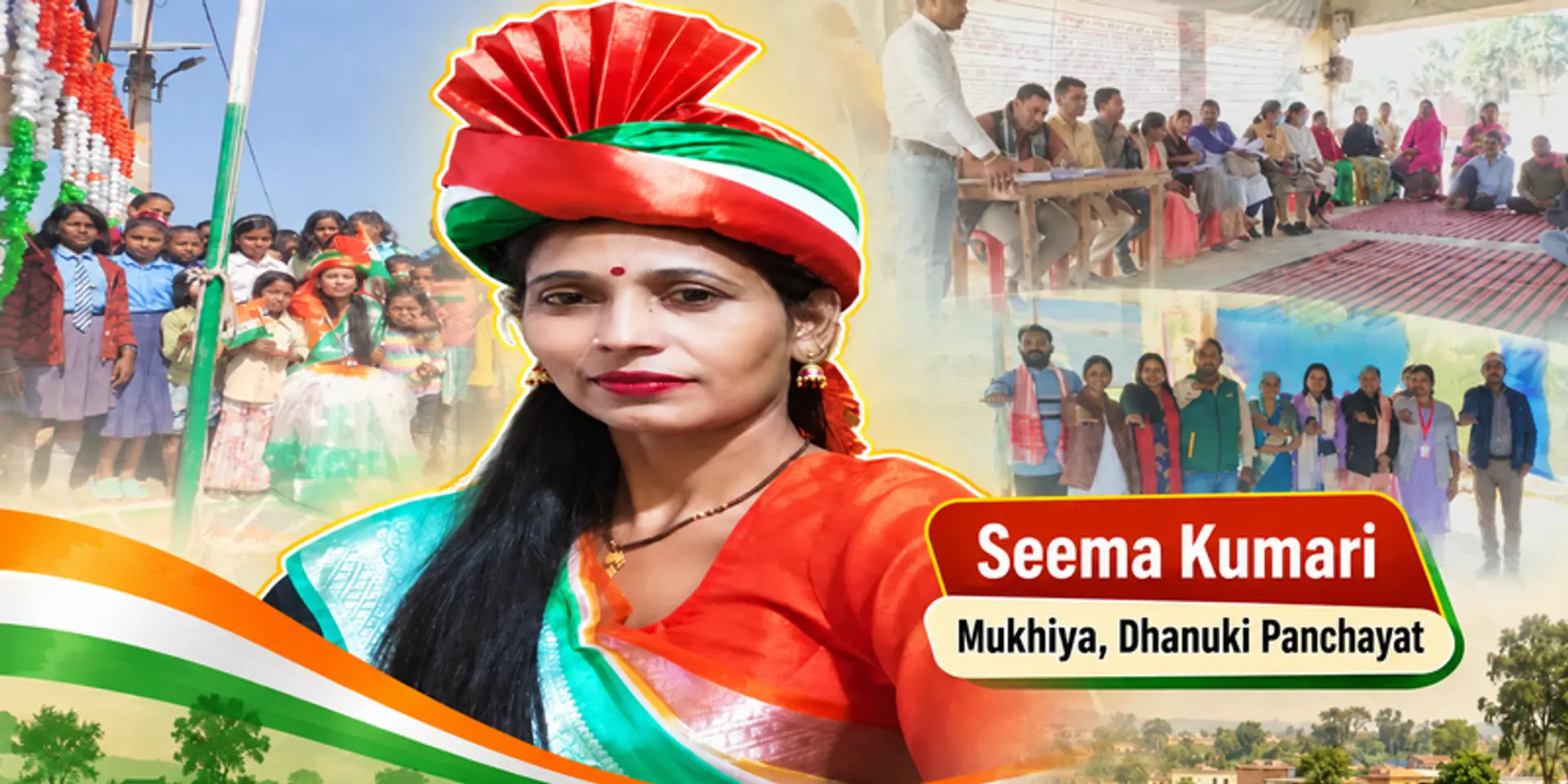

In Dhanuki Panchayat of Sarmera block in Bihar’s Nalanda district, Seema Kumari is popularly known as the ‘Nimki Mukhiya’. Today, she is recognised as a responsible and active woman leader. Whenever she visits different government offices for panchayat-related work, people recognise her and know her by name.
But reaching this position was not easy.
Seema Kumari spent a significant part of her life managing household responsibilities. She was interested in education and had a desire to understand society, but after marriage, her life became largely confined to her home.
Whenever she visited her village to cast her vote, she interacted with local residents and noticed a significant gap between her educational background and the condition of the village. This led her to question whether her education could be used to contribute to society.
That question eventually pushed her towards politics and grassroots leadership. She contested an election for the first time but lost. Instead of considering the defeat the end of her journey, she tried again. In her second attempt, she won and began working on the development of her panchayat.
Education shaped her thinking, father inspired her
Seema Kumari was born into a middle-class family. Her father placed great importance on education and believed that everyone should have an equal opportunity to study and progress in life.
From childhood, Seema closely observed her father’s social work and often participated in it.
After completing school, she went to college and earned her graduation degree. She still wanted to continue her education, but considering the responsibilities of the family, she eventually got married.
Even after her marriage, her father continued encouraging her to pursue her studies.
Seema recalls, “My father always told me that education is very important. He explained to me that education is not only for oneself but can also be used to serve society.”
After marriage, much of her life revolved around household responsibilities. At times, she wondered why, despite completing her graduation, her role had become limited to managing her home.
The question of whether she could contribute to society gradually became stronger in her mind.
Village problems gave her a reason to enter politics
While living in the city, Seema would return to her village whenever elections were held. These visits gave her an opportunity to interact with villagers. She would walk through the village, speak to residents and listen to their concerns.
She realised that the village faced challenges beyond poverty, including gaps in education, healthcare and basic infrastructure. Many residents were unaware of government schemes, while others did not know how to access the benefits available to them.
She began to see a clear contrast between her education and the problems faced by people in her village. She felt that having an education also came with a responsibility to use it for the benefit of others.
During her conversations with villagers, some residents suggested that she contest the panchayat election.
She says, “People told me, ‘Why don’t you contest the election? You are educated. If you become the Mukhiya, our village will benefit.’ That day, I also felt that perhaps this was what I should do.”
She decided to enter the election.
Her first attempt ended in defeat. However, she did not give up. She continued meeting people, understood where she had fallen short and prepared herself for another opportunity. When she contested the election again, she won and began focusing on development work in the panchayat.

A symbol of women’s empowerment
After becoming Mukhiya, Seema began directly interacting with residents to understand the problems facing the panchayat. She believed that the first step towards successfully implementing any development plan was understanding the actual needs of the people.
She worked to create awareness about government schemes and helped residents understand the schemes and facilities available to them.
Under her leadership, repair work was carried out at a school, a new Anganwadi centre was constructed, and efforts were made to improve roads and build permanent drainage systems.
However, for Seema, development was not limited to roads and drains. She also wanted women in the panchayat to become financially independent and stand on their own feet.
With the support of a local NGO, training camps in stitching and embroidery were organised for women and girls who had limited or no formal education.
The objective was to help women develop skills that could provide them with opportunities to earn rather than remain financially dependent on others. They were also given information about different employment opportunities.
Seema says, “I wanted the women in our village to not remain confined to their homes. I wanted them to learn a skill and become self-reliant. That is why we started stitching and embroidery training.”

Water conservation through jal chaupals and street plays
Water conservation has also been one of Seema’s priorities in Dhanuki Panchayat. She believes that water scarcity could become one of the biggest challenges for rural communities in the coming years.
To create awareness about the importance of water, jal chaupals were organised in the village. During these gatherings, residents discussed water availability, responsible usage and ways to conserve water for the future.
Soak pits were constructed in public areas to support better water management. Street plays were also organised to spread awareness about responsible water use. Members of a local NGO and the health department participated in these initiatives.
According to Seema, the Gram Sabha plays an important role in identifying village problems and finding solutions. She also worked towards making panchayat meetings more regular.
She participated in training programmes organised at the district level as well. To take forward work related to the Gram Panchayat Development Plan (GPDP), a team was formed and emphasis was placed on holding monthly meetings.
Seema says, “If we save water today, we can secure a safer future for the coming generations. We started initiatives such as jal chaupals and street plays to explain this message to people in a simple way.”
Recognition received, but the journey continues
Seema Kumari’s work has received recognition at both the state and national levels. For her efforts towards empowering women, she has received a state-level Nari Sashaktikaran Samman award. Her work in the field of water conservation has also received appreciation and recognition at the national level.
Despite these honours, Seema remains focused on the challenges that lie ahead. She wants to further improve education, healthcare and nutrition for girls in the panchayat.
She believes that the development of a village can only be considered complete when its daughters have equal opportunities to learn, grow and move forward.
A journey that began with household responsibilities has now taken Seema to the leadership of her panchayat. From losing her first election to winning the second and then working on grassroots development, her story shows that leadership does not come simply with holding a position.
It requires listening to people and standing with them through their problems.
For Seema, the position of Mukhiya is a responsibility rather than an achievement in itself. Her larger goal is to ensure that residents of the panchayat have access to facilities and opportunities that are often associated with urban areas.
Seema says, “I have realised that a woman can lead just as strongly as anyone else. My goal is to ensure that every family in the panchayat benefits from government schemes and facilities. In the coming years, I especially want to work towards improving education, healthcare and nutrition for girls.”
Her story is also the story of a village where change begins with small steps. One woman first understood her own circumstances, then recognised the needs of her community and eventually accepted the responsibility of leadership.
Today, her focus remains on making Dhanuki Panchayat better than it was before.