



Policy reforms and Indo-US trade: Why 2026 could be a ‘turning point’ for Indian MSMEs
As India deepens trade negotiations with the US and rolls out ambitious export promotion initiatives, MSME founders and business experts share how upcoming policy reforms and evolving bilateral relations could unlock unprecedented growth opportunities in 2026.

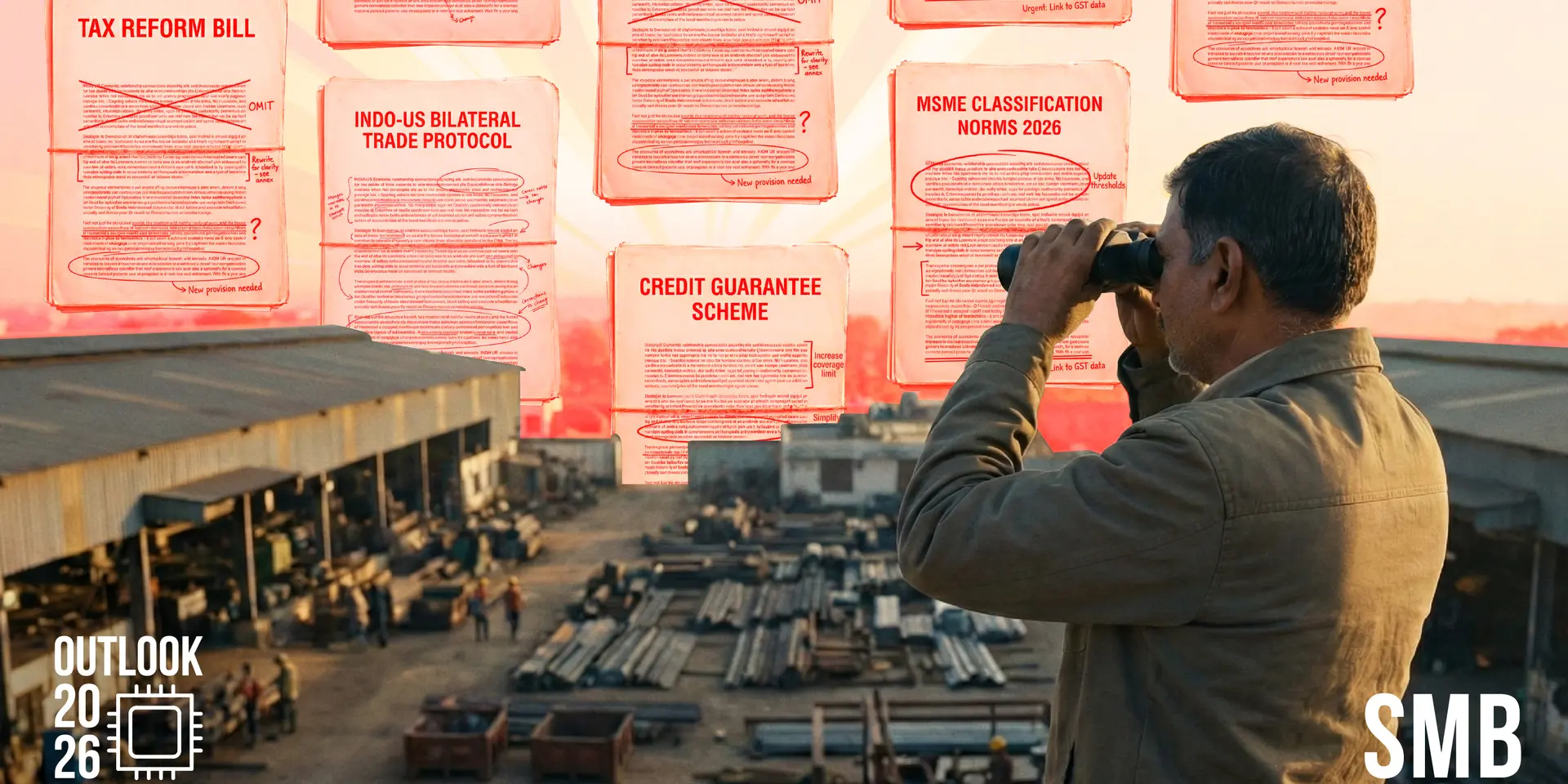

India's micro, small, and medium enterprises (MSMEs) are entering 2026 with cautious optimism. After years of regulatory complexity and global trade uncertainties, a combination of domestic policy reforms and evolving international partnerships—particularly with the United States—is creating conditions that could reshape opportunities for the country's 6.82 crore registered MSMEs.
According to government reports, the stakes are substantial.
MSMEs account for 30.1% of India's GDP, 35.4% of manufacturing output, and 45.73% of the country's exports, while providing employment to 28 crore people. For an economy aiming to reach $5 trillion, the performance of this sector isn't just important; it is essential.
Building blocks for growth
The Union Budget 2025-26 has laid the groundwork that industry experts view as potentially transformative. Most significantly, the government expanded MSME classification limits, raising investment thresholds by 2.5 times and turnover limits by two times.
This translates to more businesses accessing MSME benefits while scaling operations, a move that addresses a long-standing constraint where growth meant losing crucial policy support.
"We are optimistic about the continued implementation of expanded MSME classification and enhanced credit support introduced in Budget 2025-26," says Utsav Panchal, Director and CEO of Rajesh Power Services Limited. "These reforms simplify financial access, reduce collateral hurdles, and encourage growth without losing policy benefits."
The budget also introduced an Export Promotion Mission with a total outlay of Rs 25,060 crore for FY 2025-26 to FY 2030-31, replacing fragmented schemes with a unified framework. This mission, jointly driven by the Ministries of Commerce, MSME, and Finance, specifically targets easier export credit access, cross-border factoring support, and assistance in tackling non-tariff barriers.
For Cheruku Srikanth, Founder and CEO of Digital CFO, the most exciting development isn't just about traditional schemes.
"I am particularly excited about the real impact the Unified Lending Interface (ULI) can have on MSMEs and priority sector lending," he says. Explaining: "ULI has the potential to do for credit what UPI did for payments, standardise workflows, reduce friction, and dramatically shorten turnaround times."
This digital infrastructure push, encompassing faceless tax assessments, digitised GST compliance, and platforms like OCEN, UPI, and ONDC, represents a shift from compliance-heavy regulation to data-driven, trust-based governance.
For MSMEs operating with limited administrative bandwidth, this reduction in paperwork and time spent on regulatory formalities translates directly to a competitive advantage.
The US connection
As these domestic reforms take shape, India's trade relationship with the US is evolving rapidly. According to media reports, the US remained India's largest trading partner for the fourth consecutive year in 2024-25, with bilateral trade valued at $131.84 billion, including $86.5 billion in exports.
At present, both nations are negotiating a bilateral trade agreement, with leaders directing officials to more than double bilateral trade to $500 billion by 2030.
The United States ran a $45.7 billion goods trade deficit with India in 2024, while India's average applied tariff of 17% stands significantly higher than the US average of 3.3%.
For MSMEs, however, the focus isn't on macro trade numbers; it is on tangible market access.
"As US companies move their supply chains from a single location, Indian MSMEs will be able to play a significant role in contract manufacturing, sub-assemblies, and value-added products meeting global quality standards," notes Kalpesh Ramoliya, Founder and Chairman, Raj Cooling Systems.
Tushar Gupta, Director of Operations at Thermocool Home Appliances, sees the opportunity extending beyond direct exports. "This offers not only an opportunity to export directly into the US market but also the chance to form part of US-centric supply chains through OEM partnerships and contract manufacturing deals," he says.
The sectors poised to benefit most are clear across expert responses. This includes consumer durables, electrical goods, auto components, precision engineering, and sustainable consumer products.
Rahul Singh, Co-founder of EcoSoul Home, highlights a specific niche: "The US market is strong for Indian MSMEs, especially in terms of sustainable consumer products, particularly products being developed as alternatives to single-use plastic."
Aayushi Jain, Co-founder of DryM Foods, points to another demographic opportunity. She says, "One of the biggest opportunities lies in serving the growing Indian student and young professional population in the US. Authentic, convenient Indian food products that are shelf-stable and easy to use have strong demand."
The tariff question
Potential tariff realignments between India and the US could improve price competitiveness. However, sector experts emphasise a broader strategic value.
"Tariff realignments with the US are not just about improved access to one market; they act as a catalyst for strategic diversifications and operational efficiency," explains Srikanth.
Exposure to tariff risks in one geography forces MSMEs to diversify markets, that is, expanding into the UK, EU, Japan, the Middle East, and Africa.
"MSMEs serving newer markets must become more cost-efficient, process-driven, and compliance-ready," he emphasises, adding, "Over time, this operational maturity makes MSMEs more competitive globally, including in high-margin markets like the US."
This is not just in theory. When tariffs on competing markets increase, the question becomes whether Indian MSMEs can step in as reliable alternative suppliers. The consensus among experts is yes, however, with important qualifications.
"Indian MSMEs can step in as reliable alternative suppliers if tariff shifts accelerate buyer diversification, but reliability will be earned through execution discipline, not cost alone," emphasises Srikanth.
Global buyers will shift only when MSMEs can demonstrate consistent quality at scale, traceability and compliance, and delivery reliability.
Export-ready or not?
A critical reality check emerges when experts discuss MSME preparedness to leverage favourable trade structures. Srikanth divides MSMEs into two groups—’export-ready’ businesses that already operate with correct HS classification, documentation for rules of origin, stable quality systems, and the ability to respond to buyer audits; and those that are ‘not fully ready’.
The challenges for the latter group include documentation issues, compliance and standards readiness, working capital constraints, and process knowledge gaps around Incoterms, warranty clauses, and delivery SLAs.
"The biggest gap is tariff literacy plus process infrastructure," Srikanth notes. "Many MSMEs do not systematically track how incentives flow through the value chain."
This explains why government-led export facilitation becomes mission-critical. Faster customs clearances reduce inventory holding costs and delays, effectively removing a ‘hidden tariff’.
Enhanced trade finance and credit insurance enable MSMEs to accept larger orders and offer competitive payment terms. Market access programs lower customer acquisition costs and credibility barriers.
Ramoliya puts it simply: "Government intervention through facilitation will be paramount. The difference between intent and execution for MSMEs entering competitive global markets will be made by faster customs clearances, accessible trade finance, export insurance, and targeted market access programs."
What MSMEs need
When asked what policy signals would give them confidence to invest in capacity expansion or quality upgrades for international markets, the responses converge on a single theme: predictability.
"Long-term policy stability, export-related incentives, assistance for technology adoption, and more straightforward access to low-cost financing would create the required assurance," says Ramoliya.
"MSMEs put their money into the market when they are certain about the demand and are sure of government support for a long period," he adds.
Srikanth communicates what this means operationally: "Multi-year stability of export incentives and duty remissions, with minimal retrospective changes. Time-bound, automated GST/export refunds and predictable remission timelines so margins are not trapped in receivables. Affordable, longer–term capital expenditure credit, linked to exports, plus stronger export credit insurance."
The recent extension of the export realisation period from nine to 15 months by the RBI is exactly this type of measure: easing cash-flow pressure and compliance stress for MSME exporters facing longer payment cycles.
2026: A year of potential
So is 2026 the turning point? SMBStory asks experts.
"Yes, 2026 has the makings of a tilt-year for growth-oriented MSMEs, provided policy execution matches policy intent," says Srikanth.
"If export rules stay predictable, refunds move on time, trade finance deepens, and clearances become faster, MSMEs can convert global partnerships into what matters most: repeat orders, not one-off enquiries," he adds.
Gupta frames it as a convergence: "Policy stability, stronger global partnerships, and increased recognition of MSMEs as economic drivers are coming together in a meaningful way.
As trade frameworks evolve and export facilitation improves, MSMEs that are prepared to invest in quality, compliance, and scale will find significant opportunities."
The critical caveat appears consistently: MSMEs don't need miracles; they need fewer surprises.
Jain captures this sentiment: "When founders know that regulations will remain predictable and supportive, it becomes easier to commit capital towards capacity expansion and quality upgrades for international markets."
Singh further adds: "Thanks to stronger global partnerships, rising demand for sustainable products, and very clear policies, growth-oriented MSMEs can get out of survival mode and concentrate on long-term growth. The opportunity is very big if the execution and policy consistency remain in line."
Ramoliya's assessment reflects the mood: "The year 2026 could be a turning point. Because of domestic policy consistency and the establishment of stronger global alliances, mainly with the US, MSMEs can transform from being suppliers forced by cost to being participants in the global market driven by value. The groundwork is done; implementation will determine the outcome."
For India's 6.82 crore MSMEs, 2026 represents more than just another year. It's a test of whether the convergence of domestic reforms and international opportunities can finally translate into sustained, scalable growth, moving small businesses from adaptation mode to expansion mode, from cost competition to value creation, and from regional players to global supply chain partners.
Edited by Jyoti Narayan