


How these startups are transforming lives with assistive technology
From bionic hands to AI-powered gloves, these Indian startups are building life-changing assistive technologies to empower people with disabilities.

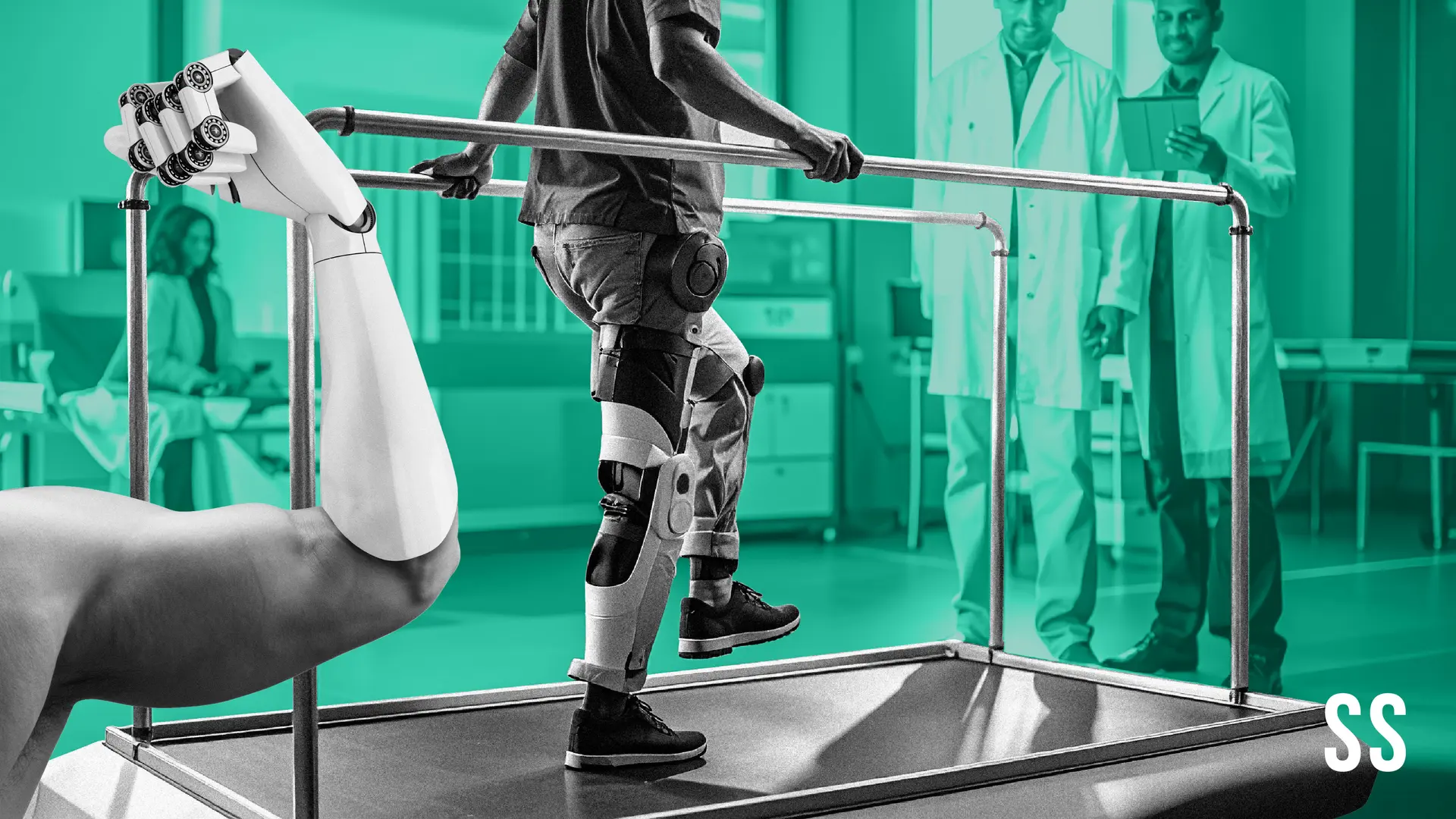

In 2020, 24-year-old Shailesh Kumar from Gaya recorded India’s fastest wheelchair half-marathon time using NeoFly, a customised wheelchair by Neomotion. It was proof that the right innovation can unlock hidden potential.
In a classroom miles away, a visually impaired child is mastering Brialle independently with Thinkerbell Labs’ Annie. And in rural India, blind girls wearing Smart Vision Glasses are now reading aloud from textbooks, identifying currency, and even navigating streets safely.
These are real-life examples of how assistive tech startups are rewriting what access, dignity, and independence mean for those living with disabilities.
In India, where more than 70 million people live with disabilities, assistive technology startups are blending innovation with empathy to break barriers in mobility, communication, education, and daily living. These startups are creating innovative and accessible products that help them move from dependence to independence.
Here are some inspiring assistive tech startups in India driving innovation and social impact to empower people to live with dignity and freedom.
Aether Biomedical
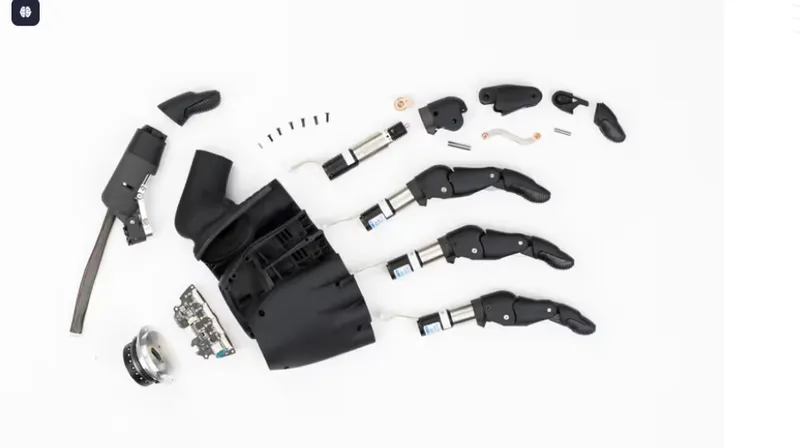
The Zeus hand
Aether Biomedicals’ flagship Zeus is an award-winning product founded by Dhruv Agrawal and Dr Faith Jiwakhan. The team set out to create the strongest and most reliable bionic hand for people who depend on prosthetics not just for mobility, but for their livelihood.
According to the founders, Zeus, with a grip force of 34.17 lbf/152N, delivers strength that no other bionic hand in the market currently matches. It can carry up to 77 lbs (35 kgs), making it a game-changer for medium to heavy-duty tasks that users face daily.
Aether focused on a crucial insight—most amputations occur among blue-collar workers who need prosthetics to perform physically demanding work. Zeus was engineered with this in mind, combining ruggedness and functionality to meet their unique needs.
One of Zeus’s standout features is its modular design, built like Lego blocks. If a finger breaks, the clinician simply replaces it on-site in less than 30 minutes. This eliminates the long delays and costs that usually come with shipping prosthetic devices for repair.
It wasn’t just the hardware that needed rethinking—the software did too. Aether built an entire digital platform that works as a digital twin for each patient. The system monitors how users operate the device, offering real-time insights to improve rehabilitation and enhance performance.
Trestle Labs
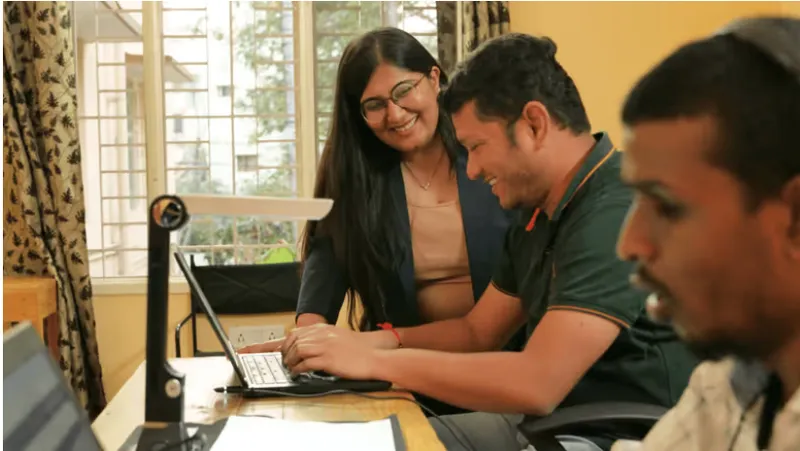
Akshita Sachdeva with a Kibo user
During her engineering days, Akshita Sachdeva built a prototype glove with a finger-mounted camera and vibration sensors. During trials with the National Association for the Blind, a young boy used it to read the newspaper and navigate around obstacles. Seeing the joy on the boy’s face, Sachdeva turned down campus placements and doubled down on building technology for accessible education and livelihoods.
In 2017, she and Bonny Dave co-founded Trestle Labs and launched Kibo—short for Knowledge-In-a-Box. This device can listen, digitise, translate, and “audiotise” printed, handwritten, and digital content across 60 global languages. Since its launch, Kibo has empowered over 180,000 visually impaired users across 650+ institutions—including IITs, IIMs, and even the Indian Parliament library.
Thinkerbell Labs
In 2014, three BITS Pilani college classmates Aman Srivastava, Sanskriti Dawle, and Dilip Ramesh developed a prototype for the world’s first self-learning Braille device for the visually impaired.
The dicta-teacher designed to help the Braille alphabet was called Project Mudra. This was later developed into Annie, a device that can be used by a blind student to read, write, and type in Braille, on their own.
Packed with gamified and interactive lessons, Annie turns Braille learning into an engaging experience. Its tactile hardware modules, combined with a warm, human-like voice that guides students step by step, reduce the need for constant supervision. Annie also provides instant evaluation and intelligent feedback, ensuring that learners are gently corrected and supported as they progress.
Smartvision Glasses
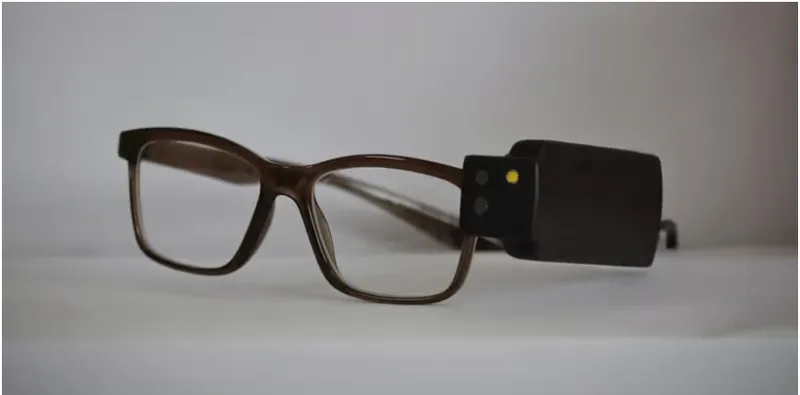
Smart Vision Glasses
Smart Vision Glasses, developed by Seetharam Muthangi, is a device attached to a pair of eye glasses to assist the visually impaired in reading, object recognition, face recognition, or as a walking assistant, with the help of tech tools like artificial Intelligence and machine learning. All one needs is a mobile phone and Bluetooth neckband provided with the glasses.
Muthangi developed the Smart Vision Glasses’ prototype in 2018 and launched it in 2023. The lightweight wearable has five major functions. The buttons on the frame are in Braille and are touch sensitive. It is connected to a mobile phone with the help of an application.
The Smart Vision Glasses use LIDAR technology to help visually impaired users identify objects around them. When the “Things Around You” mode is activated, the glasses can indicate if there is a laptop in front, a glass of water nearby, or a mobile phone to the left. The information is relayed through a Bluetooth neckband in the form of an auditory response.
In “Read” mode, the device switches on a camera that captures printed text and uses Optical Character Recognition (OCR) to convert it into speech within seconds. The text can be read aloud in multiple languages and in two types of Indian accents.
Another feature allows users to recognise and save faces. The glasses identify whether a person is male or female, estimate their age, and then prompt the user to add their name. Once saved, the device can recognise and recall up to 150 people.
The Smart Vision Glasses also act as a walking guide, alerting the wearer to obstacles such as potholes, rubble, zebra crossings, or even a dog lying on the road. An emergency mode further enhances safety by holding down a button for two seconds, the device automatically sends a WhatsApp message with the user’s location to a preset emergency contact.
The company works with blind schools, Rotary Clubs, and Vision Aid has been instrumental in identifying people, and giving grants to buy glasses for those in various blind schools. Help the Blind Foundation also obtains CSR funds from companies like Cognizant, Wipro, and others, buys glasses from SHG, which provides training, assistance, and maintenance.
Dhanvantri Biomedical Pvt Ltd
During her fellowship at BIRAC, Sruthi Babu visited a hospital in Coimbatore where she met a paralysis patient whose agony stemmed not from his condition, but from the humiliation of relying on his daughters for basic hygiene. His words, “It’s better to die than be a burden on my daughters”, moved Sruthi deeply and spurred her to rethink mobility solutions. Thus Sahayatha was born as a smart wheelchair with an integrated self-cleaning commode designed not only for practicality, but for preserving dignity.
Built under the banner of Dhanvantri Biomedical Pvt Ltd, Sahayatha went through 118 design trials and five prototypes before gaining approval to be tested in hospitals. The final product, launched on May 8, 2022, comes in two variants: the S100, which reclines 180° to function like a stretcher, and the S200, a non-reclining model. With the simple press of a button, a jet spray cleans the patient, and a detachable bidet module ensures easy waste disposal—all without the need for multiple caregivers.
The wheelchair has garnered attention and validation through grants, pilot trials, and eventually a five-Shark deal worth ₹1 crore for 10% equity on Shark Tank India Season 2 .
Neomotion
NeoMotion emerged after its founders Swostik Sourav Dash, Siddharth Daga, Ashish Sharma, and their mentor Prof. Sujatha Srinivasan from IIT-Madras, interacted with over 200 wheelchair users across 40 locations in India. The realisation was stark: most existing wheelchairs were one-size-fits-all, confining users indoors and compromising their dignity. This insight inspired NeoMotion to create solutions that prioritize independence and mobility.
Since launching in 2020, NeoMotion’s flagship products, NeoFly and NeoBolt, have transformed lives. NeoFly is a custom-made, compact wheelchair with up to 18 personalisation parameters tailored for each individual’s posture, body dimensions, and terrain. When fitted with NeoBolt, a motorised clip-on, the wheelchair transforms into a rugged, all-terrain vehicle capable of traveling up to 30 km on a single charge in just four hours.
The startup has garnered high-profile endorsements and partnerships. Zomato, for instance, works with NeoMotion as a livelihood partner, and over 500 wheelchair users now deliver food, earning sustainable incomes. Tamil Nadu’s Department of Differently Abled has funded 600 users over three years.
Glovatrix
From her school days, Aishwarya Karnataki felt a deep pull toward the deaf community. In Class 8, she first met a classmate named Atharva, who was brilliant, but isolated because none could interpret his sign language. She taught herself sign language just to be his friend.
In 2020, during her MBA prep, the pandemic cancelled her plans to study abroad, but fate intervened when she met Parikshit Sohoni. With aligned values and a shared passion, they launched Glovatrix, a Pune-based startup focused on empowering the deaf and speech-impaired through AI-powered assistive wearables.
Their flagship product, FifthSense, is a sleek, wearable glove equipped with sensors that map hand and finger movements in 3D. Users press a button, make gestures, and the AI — trained on 100 signs with 98% accuracy — translates them into spoken words via an inbuilt speaker. A built-in microphone captures speech from others and converts it into text for the wearer.
Glovatrix has launched its eighth hardware iteration and a second app version. Initially targeting the B2B market, they plan to launch commercially and later transition to a B2C model as unit costs decrease.
Their work has earned significant recognition: equity-free grants and awards, including Startup India Seed Fund, Nidhi Prayas, BIRAC Big grant, and “Best Women-Led Assistive Tech Startup”.
Edited by Megha Reddy