


Year in review: Meet the people who transformed 2025 into a year of social action and structural change
While policies and budgets set the backdrop for social progress, real change often begins with people who refuse to wait. These 10 individuals exemplify the determination and imagination that defined India’s impact landscape in 2025.

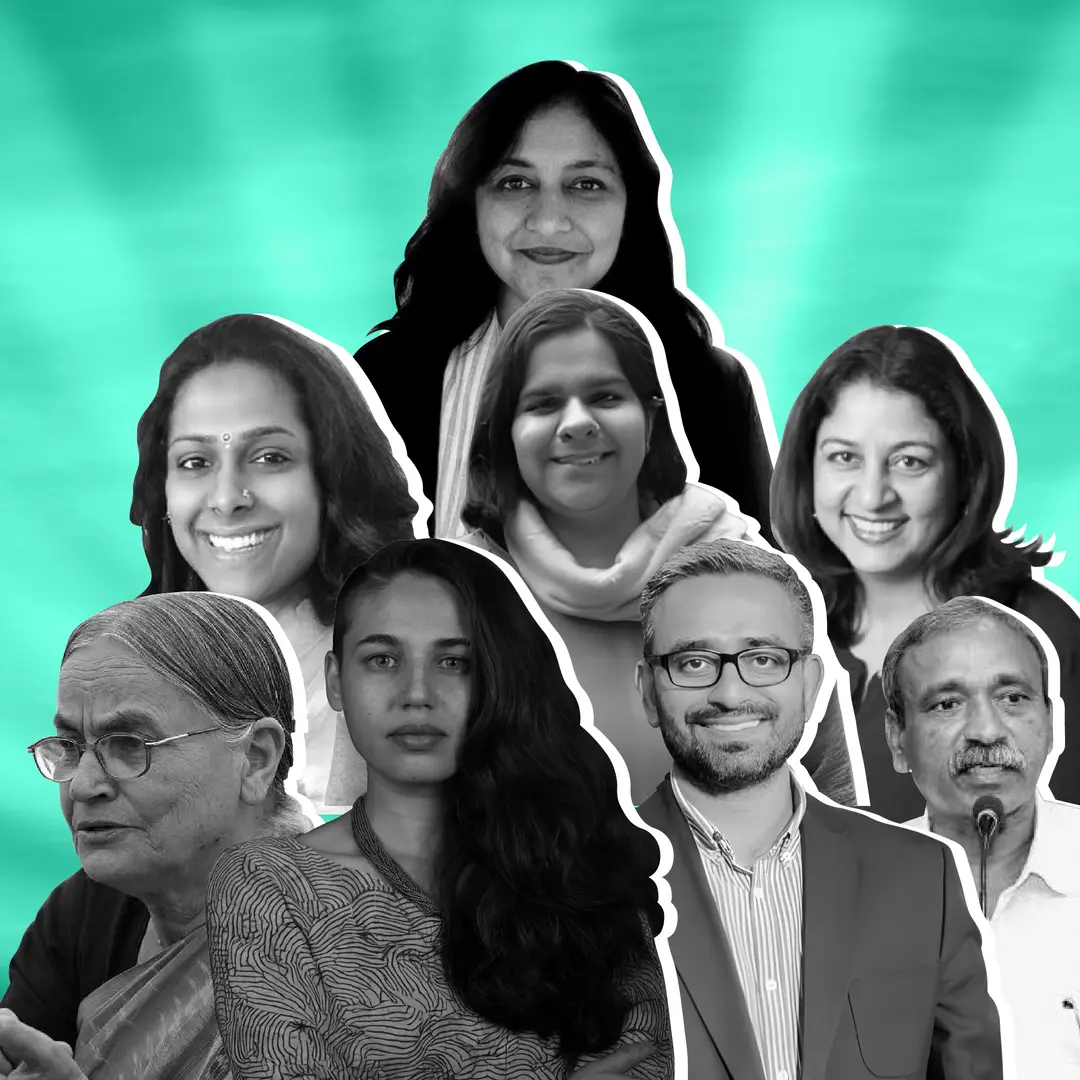

In the year 2025, many of India’s changemakers worked towards transforming lives across education, mental health, disability justice, environmental care, road safety and digital livelihoods.
At the same time, the government took steps to strengthen the social-sector ecosystem. Budget 2025 expanded support for disability welfare, raising allocations under schemes such as the Deendayal Disabled Rehabilitation Scheme, enhancing aid for assistive devices, scholarships and rehabilitation services. Meanwhile, renewed focus on inclusive education and state-level proposals to reserve seats and jobs for persons with disabilities signalled growing institutional acceptance of equal access.
In a world grappling with crises—climate, growing inequalities, mental-health stress—this alignment between grassroots changemakers and state action becomes necessary and signals hope.
Here, we profile ten such individuals who made the world better in 2025: from rebuilding ecology deep in drought-hit regions, to winning a seat for India’s first blind woman in the Supreme Court, to making AI-work and mental-health care accessible.
Their stories chart the pulse of Indian social change in 2025.
Safiya Husain, Founder, Karya
Safiya Husain Co-founded Karya in 2021 along with Manu Chopra and Vivek Seshadri, building on a Microsoft Research project to create a Bengaluru-based non-profit that offers dignified digital livelihoods to low-income and marginalised communities.
Karya trains rural and economically vulnerable workers, many of whom are first-time smartphone users, to undertake tasks such as speech-dataset generation, annotation and other AI-training work. The organisation pays significantly above typical gig rates, opening pathways to income stability, digital skills and social mobility.
“We work with the most disadvantaged communities and enable them to earn from data work that pays well and respects their dignity,” she says.
In 2025, she was awarded the SheSparks AI Award by YourStory Media under the 'Future Shapers: She Leads Change Awards', recognising her efforts to make AI more inclusive while expanding economic opportunity for underserved communities.
Piyush Tewari, Founder-CEO, SaveLIFE Foundation
Piyush Tewari has spent nearly two decades trying to make India’s roads safer. As the founder and CEO of SaveLIFE Foundation, a Delhi-based, non-profit public policy organisation that works to reduce road crash deaths, he has pioneered systemic reforms, including pushing for the country’s Good Samaritan Law, a legal protection that ensures bystanders who help road-crash victims are not harassed, questioned unnecessarily, or held liable by police.
“The reasons for such a high number of road crash fatalities in India are bad road user behaviour, flawed road design and engineering, weak enforcement of traffic laws, and lack of rapid trauma care,” he says.
Through the foundation in 2016, he developed the Zero Fatality Corridor (ZFC) model, first applied to the Mumbai–Pune Expressway, cutting road-crash deaths by over 50% on that stretch.
In 2025, he was awarded Social Entrepreneur of the Year–India 2025 by Jubilant Bhartia Foundation in partnership with Schwab Foundation, for the most recent phase of his work with ZFS, which reportedly cut road-crash fatalities by up to 67% across 36 highways in 16 states.
Through his sustained vision, data-driven interventions and legal reform, Tewari remains one of India’s foremost agents of road safety.
Safeena Husain, Founder, Educate Girls
Safeena Husain launched Educate Girls in 2007 as a non-profit based in Mumbai and working across rural and underserved regions of India to identify out-of-school girls and bring them back to school through community mobilisation and government partnerships.
Educate Girls mobilises communities and works with state systems to ensure girls enter classrooms and continue their education.
Under her leadership, the organisation expanded from a pilot in a few villages of Rajasthan to operating across more than 30,000 villages nationwide, enrolling over two million girls and reaching millions of children as of 2025.
In 2025, Educate Girls became the first Indian organisation to win the Ramon Magsaysay Award - Asia’s highest public-service honour - recognised for “its commitment to addressing cultural stereotyping through the education of girls and young women, liberating them from illiteracy and infusing them with skills, courage and agency.”
“This award is for our girls, who inspire us with their courage, grit, and resilience,” Husain said on receiving the honour.
Sonam Wangchuk, Environmentalist & Founder, SECMOL
Sonam Wangchuk founded the Students’ Educational and Cultural Movement of Ladakh (SECMOL) in 1988, creating an alternative educational ecosystem for young people in Ladakh rooted in practical learning, sustainability and local knowledge systems.
SECMOL works to improve government-school outcomes and promote climate-adapted infrastructure.
Wangchuk is best known globally for innovations such as the Ice Stupa artificial glacier, a water-conservation solution for Himalayan villages, and for his climate activism in Ladakh.
In 2025, he drew national attention when he led peaceful protests advocating constitutional safeguards, environmental protection and sustainable development for Ladakh, reaffirming his longstanding commitment to ecological justice.
His work continues to highlight how climate vulnerability, geographic isolation and cultural identity intersect in the Himalayan region.
Anchal Bhateja, Advocate & Disability-Rights Leader
2025 marked a turning point for disability justice in India, and at its centre stood Anchal Bhateja, the first blind woman to argue a case before the Supreme Court.
Bhateja became the first blind woman to argue a case before the Supreme Court, a moment that rippled through legal circles and energised the disability-rights movement across the country. She has long championed equal access, non-discrimination and systemic inclusion in public employment and education. Her Supreme Court petition challenged recruitment norms that barred persons with blindness from certain disability categories, marking a crucial intervention in disability justice.
Bhateja’s work reflects her core belief that accessibility is a structural right, not a charitable concession. As she said in a public statement, “We want equality, not exceptions—the right to participate fully, on our own terms.”
Her landmark appearance in 2025 positioned her as one of the most important new voices in India’s disability-rights landscape.
Dr Akkai Padmashali, Social Activist & Founder, Ondede
Dr Akkai Padmashali has spent over two decades as one of India’s most influential voices for transgender rights. In 2014, she co-founded Ondede, a community-led organisation in Bengaluru that works on sexuality, gender identity and human rights through advocacy, counselling, public education and policy engagement.
Her activism has shaped national conversations on equality, informed state-level policy, and supported countless transgender persons in accessing legal rights, healthcare and safety.
“Our fight is for dignity - to live, to love, to work and to be seen”, she says.
In 2025, she received the SheSparks Social Impact Award conferred by YourStory Media under the Future Shapers: She Leads Change Awards, recognising her sustained leadership in advancing gender justice and inclusion in India.
Jo Aggarwal, Mental health advocate, Founder & CEO, Wysa
In an often-overwhelmed mental-health landscape, in 2015, Jo Aggarwal built Wysa to become a first responder of sorts, offering help the very moment someone reaches out.
Her Bengaluru-and Boston-based global mental-health platform combines AI-enabled conversational support with access to human therapists. It offers evidence-based tools for emotional well-being and has been used by over 6 million people across 95+ countries, with clinical validation from institutions including the National Health Service in the UK.
Aggarwal’s work stems from her belief that mental health support must be accessible, private and stigma-free. “We built Wysa so people could get help at the exact moment they need it, without fear or hesitation.”
In 2025, she received the SheSparks Healthcare Award by YourStory for expanding access to affordable mental-health care and advancing digital therapeutic innovation for diverse populations.
Radha Bahin Bhatt, Gandhian activist and environmentalist
Radha Bahin Bhatt has devoted over seven decades to social and environmental work in India’s Himalayan region. She founded and led several grassroots initiatives, establishing 25 children’s learning centres (bal-mandirs) that educated more than 15,000 underprivileged children; creating vocational training for women in weaving, spinning and sewing to promote economic self-reliance; and leading sustained activism around forest protection, river conservation, and community rights.
Her environmental work also intersected with landmark conservation movements: she contributed to the ethos of the Chipko movement, embracing forest protection through non-violent community resistance, and led afforestation drives across the Pithoragarh and Almora districts, planting hundreds of thousands of trees over decades.
In 2025, in recognition of her lifetime of service to women’s empowerment and environmental conservation, she was awarded the Padma Shri, one of India’s highest civilian honours, and a tribute to decades of persistent, community-centred work.
Chaitram Deochand Pawar, environmentalist & tribal-community conservationist
Chaitram Pawar, a tribal-community leader from Baripada village in Dhule district, Maharashtra, has spent decades transforming a drought-prone region through grassroots forest, water and wildlife conservation.
Under his leadership as president of Devgiri Kalyan Ashram - a community-based organisation working on ecological restoration and tribal welfare - villagers built over 500 check dams and trenches, reviving groundwater levels, renewing irrigation and restoring agriculture in a region long hit by drought. Their efforts also regenerated forest cover, preserving habitats for endangered species, 48 bird species, and more than 435 varieties of trees and shrubs.
Pawar’s model also encouraged local self-reliance. In a 2025 seminar hosted by Export–Import Bank of India, he highlighted how village-level sustainable practices, rooted in traditional knowledge and local resources, can contribute to 16 of the 17 Sustainable Development Goals.
In 2025, Pawar was awarded the Padma Shri for Social Work. It recognised his decades-long commitment to environmental justice, tribal welfare and community-led renewal.
Vinayak Lohani, Founder, Parivaar
For the last 22 years, Vinayak Lohani has built his life around transforming countless childhoods. Immediately after finishing his MBA, Lohani turned away from a corporate path to Parivaar, a home for orphaned children. He started with three children in a small rented building on the outskirts of Kolkata.
Over the years, Parivaar has grown significantly. It runs free residential institutions for orphaned, homeless and extremely vulnerable children. Parivaar has also spread beyond West Bengal to states including Madhya Pradesh, serving tribal, impoverished communities.
In 2025, Lohani was conferred the Padma Shri for his decades of service.
Edited by Affirunisa Kankudti