



How an invasive shrub is being turned into livelihoods in the Nilgiris
Introduced as an ornamental plant, Lantana camara now dominates large tracts of forest in the Nilgiris. Under a recent policy-led effort, the Tamil Nadu Forest Department is working to remove the invasive shrub and repurpose it into biomass, creating jobs for forest-fringe tribal communities.



Across the Nilgiris, the Lantana camara is hard to miss. A flowering shrub with clusters of bright pink and yellow blooms, it lines forest edges and hillsides, appearing almost decorative against the green.
But beneath its striking beauty is its invasiveness. Introduced to India as an ornamental plant, Lantana spreads aggressively, forming dense thickets that crowd out native grasses, shrubs and saplings, altering forest structure and limiting the space available for wildlife to forage and move.
It is often studied as one of the most persistent invasive species across the Western Ghats.
This month, the Tamil Nadu Forest Department began a focused effort in the Mudumalai Tiger Reserve to remove lantana from forest areas and repurpose it into biomass. The idea was to link ecological restoration with livelihood opportunities for the indigenous tribals such as Kurumbas who have been living along forest fringes for generations.
“Invasive plants and trees have been here for a really long time,” says Supriya Sahu, Additional Chief Secretary to the Government of Tamil Nadu in the Department of Environment, Climate Change and Forests. While theories vary about how lantana first arrived—with many tracing it to colonial botanical gardens—research confirms that it has spread widely across much of the country and beyond, displacing native species and persisting in the soil for decades.
Until recently, any invasive species received little systematic attention from forest governance. The Tamil Nadu Policy on Invasive Plants and Their Management (PIPER Policy), which came into effect in 2022–23, became a unique state-level framework aimed at addressing invasives such as lantana and other exotic species like Senna spectabilis—a medium-sized, fast-growing tree with a broad, rounded canopy with dense clusters of bright yellow, flowers. “That was the first strong policy we brought out,” says Sahu, noting that it laid the groundwork for practical responses to deal with the problem.
Under this policy, the Tamil Nadu Forest Department has begun clearing lantana from areas in and around Mudumalai, seeking to restore native grass, shrubs and trees that form the basis of wildlife foraging and biodiversity. Lantana’s fast spread and persistent soil seed bank, make it especially difficult to manage, says Sahu. When cut, it often re-germinates from embedded seeds, so removal must be sustained and strategic.
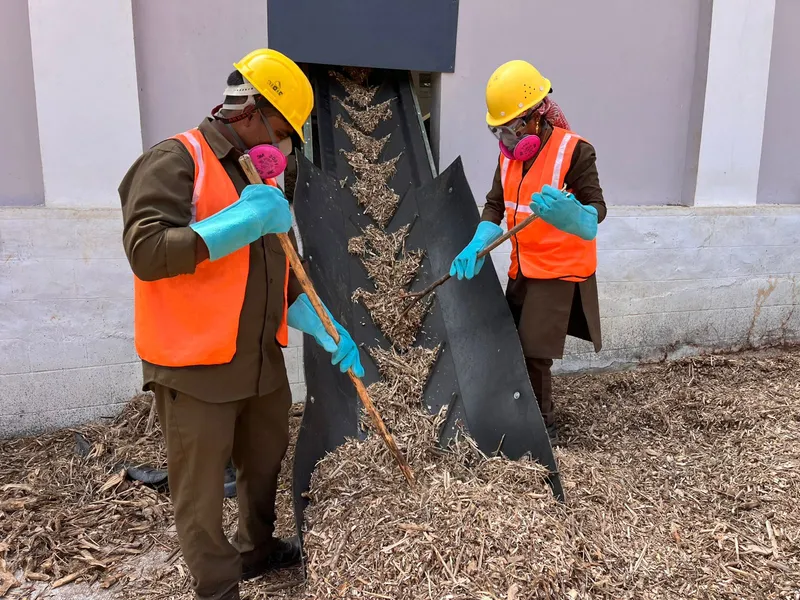
Lantana is removed from deep forest areas and processed into binder-free fuel briquettes using only pressure and heat, without chemical additives. These briquettes are then supplied to nearby tea factories, replacing wood burning with forest waste turned resource.
Rather than burning the cleared biomass or letting it rot, the department has set up a briquetting unit (a small industrial facility that compresses loose biomass into solid fuel blocks, called briquettes) in an old Electricity Board building near Masinagudi. At the briquetting unit set amid the forests of Nilgiris, nearly 125 hectares of lantana are cleared every month under a sustained restoration effort that will help reopen wildlife habitats that were previously choked by invasive growth.
Lantana is removed from deep forest areas with the active participation of local tribal communities, transported to the Masinagudi unit, and processed by tribal workers into binder-free fuel briquettes using only pressure and heat, without chemical additives. These briquettes are then supplied to nearby tea factories, replacing wood burning with forest waste turned resource.
“The tribal workers work as wage labourers directly with the Forest Department,” says Sahu. Many of these workers come from fringe forest communities where traditional livelihoods include non-timber forest product collection, anti-poaching work, and eco-tourism support. The briquetting work is another source of regular income for them, she adds.
The very structure of lantana makes it suitable for this process; its pest-free biomass and woody stems compact into solid fuel easily. Other invasive plants require different treatments. For example, Senna spectabilis is directed as pulp to Tamil Nadu Newsprint and Papers Limited, where it contributes to paper production. Each invasive species demands a tailored management process.
Why invasive plants matter
Ecologists have long warned that lantana’s spread suppresses native grass and understory plants, reducing the habitat available for herbivores and changing fire regimes. Dense lantana thickets can impede animal movement and reduce forage availability for elephants, deer and other wildlife, while also decreasing plant biodiversity. Native grasses and saplings struggle to establish themselves beneath such impenetrable growth, which in turn slows natural forest regeneration.
“Likewise, Sena spectabilis is highly toxic, and it does not allow any native tree to grow,” says Sahu. Scientists have noted that lantana releases chemicals that inhibit the growth of other plants, slowing the return of native vegetation.
By clearing lantana and turning it into a useful product, the briquetting project simultaneously reduces forest degradation and creates economic value for tribal communities—a win–win in a region recognised as part of the Western Ghats biodiversity hotspot.
Edited by Affirunisa Kankudti