



How BlackSoil Group's startup-focused supply chain financing platform grew its AUM by 7x
SaralSCF’s tech-driven lending model now anchors brands like Bluestone and DeHaat, offering working capital to thousands of small dealers and distributors across India.

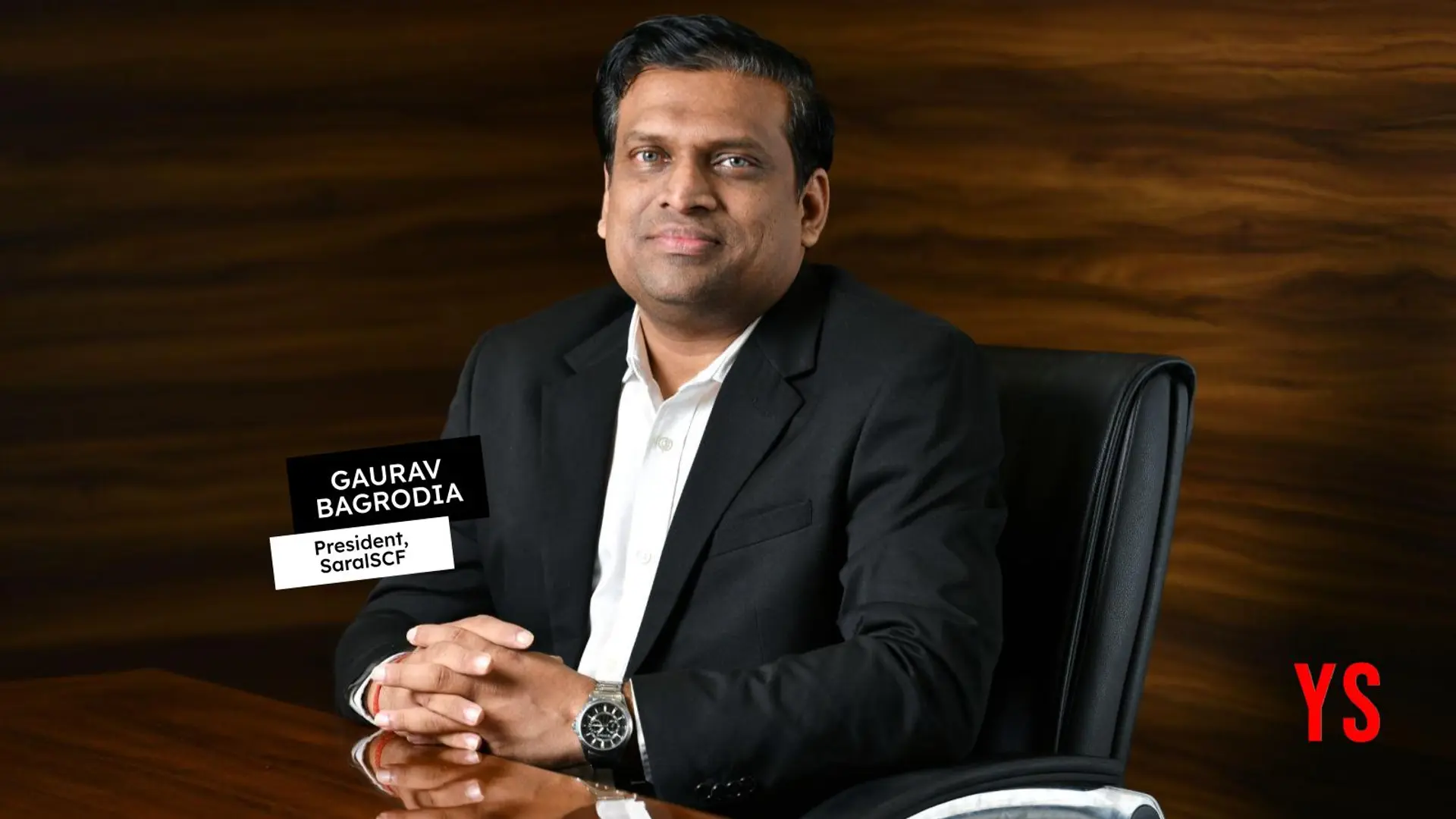

When you ask Gaurav Bagrodia, President of SaralSCF—the supply chain arm of BlackSoil Group, what’s behind the company’s brisk growth, he doesn’t boast grand strategy. “Lending is lending,” he says, almost dismissively.
"Supply chain finance is just a different product within lending. But what makes it powerful is that it addresses a massive gap in the market," he notes. "This product has got a lot of operational hassles."
While supply chain finance has existed in India for decades—companies like SBI Factors have been offering it to blue-chip clients like Mondelez and Pepsi since the 1980s—it remained largely inaccessible to unrated or low-rated companies. That's the middle ground SaralSCF set out to capture in 2021.
The appetite for supply chain financing from emerging startups is clearly reflected on the firm’s balance sheet. Assets under management (AUM) have climbed from Rs 50–60 crore in March 2023 to roughly Rs 170 crore a year later, and up to Rs 344 crore by March 2025.
“When I joined, the book was tiny,” Bagrodia recalls. “Now we’ve crossed Rs 4,000 crore of disbursements, with almost 100 live anchors out of more than 300 onboarded historically. That’s a benchmark we’ll soon break again.”
SaralSCF was born as BlackSoil’s risk-diversification experiment. “Historically, BlackSoil was doing alternative debt for growth companies—startups, mostly,” Bagrodia explains. “We wanted to diversify both the product and the risk. So we acquired a company, built our own tech stack."
Traditional banks struggle with the high-frequency, low-ticket transactions that characterise distributor financing. A single anchor company might have hundreds of small distributors, each requiring credit lines of Rs 3–4 lakh, with invoices churning every 30–60 days.
BlackSoil's solution was to acquire a company and build its own proprietary platform. The SaralSCF platform handles everything from invoice uploads and anchor approvals to automated collections and real-time portfolio monitoring.
"We built our own tech stack because you could not buy it from the market, at least in those days," Bagrodia says as he walks through SaralSCF’s dashboard. The interface features a granular view of the entire portfolio: 3,543 borrowers across multiple anchor companies, with real-time tracking of disbursements, collections, and overdue amounts down to the rupee.
The platform’s real test came when BlackSoil entered into a merger with Caspian Debt in 2024. "Caspian did not have the tech stack for supply chain, and you cannot buy it from the market," Bagrodia explains. "That was the main reason why Caspian hadn’t scaled much in the supply chain business in proportion to its AUM. But once we merged, the tech stack was available to them."
During the integration process, with access to SaralSCF's platform, Caspian added Rs 70–80 crore to the combined AUM within months and brought geographic expansion, particularly in Hyderabad. The platform also enabled cross-selling opportunities with Caspian's existing client base and added analytical and sourcing talent to the team. The merger process is ongoing and is currently awaiting NCLT approval.

What sets supply chain financing apart
Traditional working capital is a blunt instrument. A bank gives a company a credit line or overdraft based on financial statements, cash flows, and collateral. Money lands in the company's account and can be used for almost anything within broad covenants.
The loan is flexible, but so is the risk: if a borrower gets Rs 10 lakh for 60 days but sells inventory in 10 days, nothing stops them from diverting that cash elsewhere, say for shop repair or more instruments. This is where defaults may occur.
Supply chain finance operates differently. Instead of backing the company in the abstract, lenders fund specific invoices tied to goods moving through the chain. The money flows against a document, to a named counterparty, for a short window—typically 30 to 60 days. End-use is restricted to the transaction itself.
But most financiers usually prefer working with large conglomerates which make Rs 10,000 crore or more in revenues annually, as they have a better credit profile. SaralSCF tries to break the mould by making the product work for startups.

The startup problem
"If these are loss-making startups going to the market and saying, 'Please give me working capital of Rs 20 crore or Rs 40 crore,' the banks may not be ready to finance it," Bagrodia explains.
This is the constraint that makes supply chain finance valuable for growth companies. Rather than lending to the startup, lenders finance its channel partners—the distributors and dealers who purchase from the startup.
Agricultural technology company DeHaat illustrates the structure. DeHaat sells seeds, fertiliser, and crop protection products through a network of small distributors, many in Tier II and III cities. The company is capital-intensive and building rural infrastructure, making traditional bank financing difficult.
SaralSCF underwrites DeHaat as an anchor—assessing its business model, runway to breakeven, and margins—but the actual borrowers are the distributors.
"My borrower is actually the distributor, because he purchases goods from DeHaat, and I pay that money directly to DeHaat," Bagrodia explains. "So the dealer, the distributor, is my borrower, and he will sell those goods in the market, and the money will be collected and repaid."
The result: DeHaat improves its cash conversion cycle without taking on large unsecured debt. Distributors struggling to access institutional credit suddenly have working capital tied to their actual inventory needs. And the lender's exposure isn't to a single loss-making startup, but to dozens of small businesses, each tied to specific invoices with rapid turnover.
"You can pump working capital into their system, and that may help them to build and scale up that business," Bagrodia says.
Market constraints
Despite the growth, market awareness remains limited. "Supply chain finance, for a lot of companies, is a first-time product," Bagrodia says. "The understanding, processing, operationally adapting to it—it's not that easy for them."
Many potential borrowers lack digital infrastructure. "Many businesses don't have a digital presence," he notes. "Technically, you find a lot of businesses which are not available for tech integration."
Co-lending with banks—where banks and NBFCs jointly finance borrowers—remains nascent. "Co-lending has started, but it's in the initial phase only," Bagrodia says.
The company is experimenting with AI and machine learning for credit scorecards and rule engines, but Bagrodia is cautious. "Currently, the product and industry are not ready for such things. Data is not that highly available. These technologies require back data for testing. We are trying a few things, but it will take some time."
For now, the demand isn’t constrained. "There is a humongous demand in this kind of product, because working capital in India either lacks or there's massive demand," Bagrodia says. "Traditional banks have their own limitations, but when you talk about working capital availability to new-age companies, these alternate products become useful and handy."
The opportunity, he suggests, is in execution: scaling operations while maintaining credit quality and building market understanding of a product that remains unfamiliar to many potential users. "Still, there is a long time for everything to get done," Bagrodia says. "But a lot of exciting things are happening."
(The copy was updated with clarifications on the merger.)
Edited by Kanishk Singh