



How FIS’ India GCC is building scalable AI for financial services
Financial technology firm FIS is expanding its AI initiatives with a strong focus on scalability, trust, and governance. Its India GCC, employing 15,000 people across Bengaluru and Chennai, is playing a critical role in building secure AI solutions for the highly regulated financial services sector.


Global financial technology company Fidelity Information Services (FIS) is rolling out artificial intelligence (AI) solutions only after ensuring they meet three main criteria—scalability, trust, and value. Its Global Capability Centre (GCC) in India is playing a central role in ensuring these principles are embedded across deployments.
FIS made its India entry in 2003 and today employs around 15,000 people across its Bengaluru and Chennai centres. As AI adoption accelerates, the company has gone ahead in integrating this technology into building newer products that aim at higher efficiency, speed and accuracy.
However, operating in a highly regulated financial services sector requires a comprehensive approach.
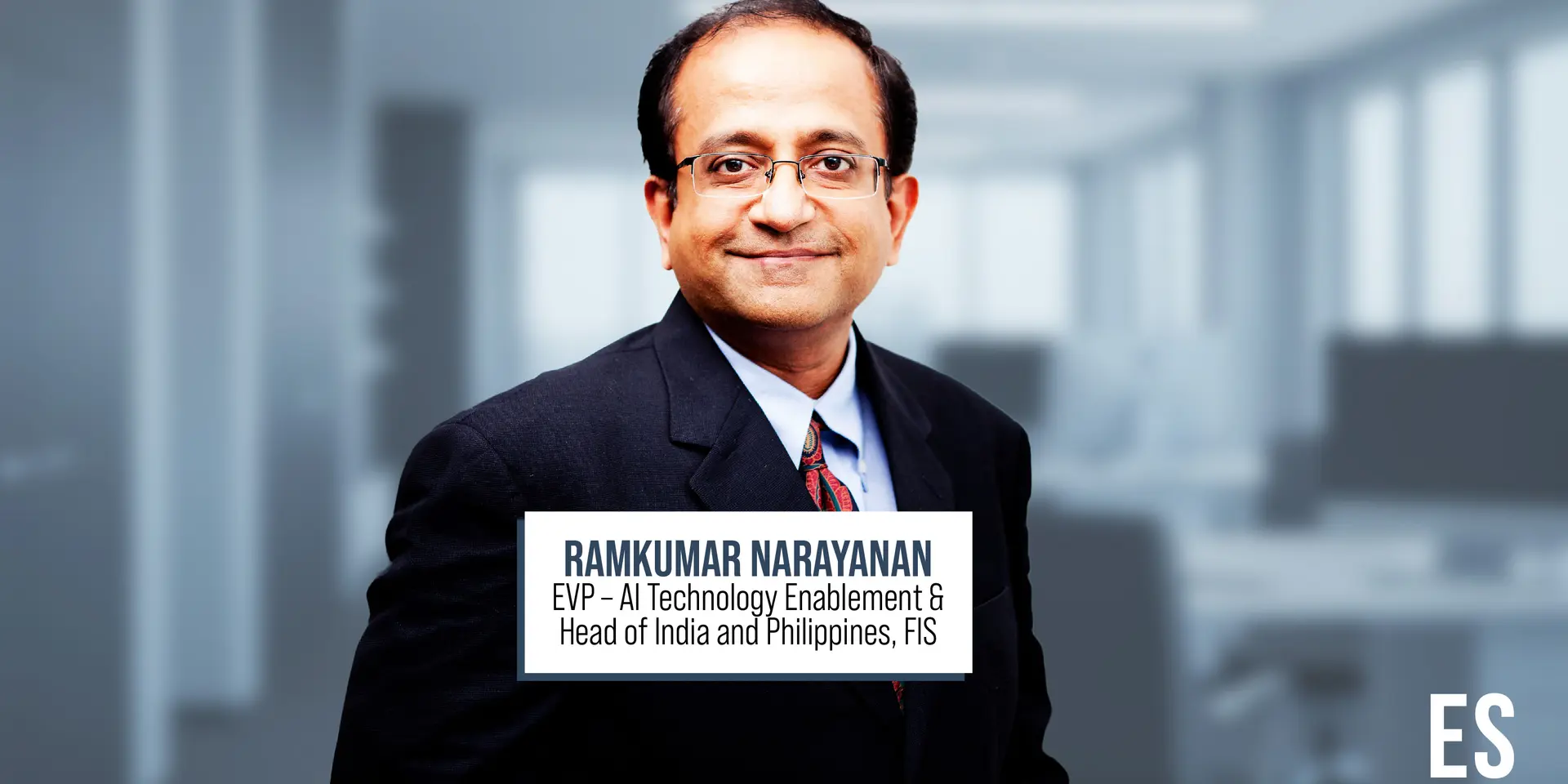
In an interaction with EnterpriseStory, Ramkumar Narayanan, EVP–AI Technology Enablement & Head of India and Philippines, FIS, said, “One of our learnings over the last couple of years in terms of AI proof of concepts (PoC) is that it gets stuck at some point on issues of governance, scale, or trust.”


India is going to lead in AI through entrepreneurship: General Catalyst’s Hemant Taneja
According to him, while engineers are excited about the various possibilities through AI, there are many factors that need to be taken into account before the solutions can actually be implemented.
As much as AI promises a lot many things, there are many hurdles to cross before it can actually be implemented as a tech solution. First and foremost is how one can safeguard the data especially when there is the usage of third party large language models. Secondly, how secure are these AI solutions, and lastly whether this can be used on a large scale. For many companies, it becomes a challenge in meeting these criterias.
To build an AI-first culture within the organisation, FIS ensured that AI tools and platforms are accessible to all its employees. For example, the rollout of Microsoft Co-pilot encouraged employees to build several AI agents and helped create internal communities focused on AI innovation within the GCC.
Building on this foundation, the GCC laid out terms to create an AI culture and also created a broader network on how one could reap the benefits of this tech platform.
Anytime any AI PoC is built, it undergoes validation from multiple stakeholders within the company such as risk compliance, governance, security and most importantly, validation from customers.
“We are getting validation from customers, and in some cases they become joint design partners in building a solution. The customer also has a skin in the game of doing this right,” Narayanan said.
FIS also benefits from having around 10-15 global leaders based out of the India GCC who oversee large teams spanning functions such as development, professional services, customer experience, and operations. Many of these leaders manage teams from within and outside India , enabling wider collaboration and getting inputs from various stakeholders while building an AI solution.
The India GCC of FIS is also leading from the front in putting together the entire AI agentic stack with the goal of developing a platform that is highly secure, especially given that this company handles sensitive financial data.
“What is different here is the AI governance where we work very closely with our risk compliance team and they are embedded as part of the working group as we design and build this right,” said Narayanan.
The company expects the number of AI agents will only increase in the coming years, and the platform has to be secure to be deployed for various use cases—be it for its customers or internal use cases. All this is done in an integrated fashion with participation from other teams like banking, payments, capital markets, client office, commercial office, etc.
Narayanan believes that by the end of this year, FIS will have many more AI PoCs that will become scalable solutions. All this is being done in an integrated manner in close collaboration with other FIS centres across the globe.
Today, AI solutions developed by FIS are helping customers perform tasks faster and more accurately in areas such due diligence or time taken to give out a loan.
Besides the positive impact for customers who are predominantly financial services companies like banks, AI adoption has also led to greater productivity among the engineers at the India GCC.
“They (engineers) are getting a lot more creative and have shifted their focus to truly understanding what is the problem they're trying to solve, rather than just taking requirements, coming to them, and building,” said Narayanan, and added that some of the top engineers are starting to deliver 3x of output effectiveness by using these AI tools.
The changes due to AI have also led to the creation of communities focused on this technology where the GCC of FIS shares the learnings with employees from other locations like the US and the Philippines.
“It is an example where the India GCC is leading the company in terms of internal engagements and opening it up to people in other markets,” Narayanan said.
Edited by Megha Reddy