



5 organisations reimagining breast cancer care in India
From radiation-free early screening and personalised treatment decisions to offering dignity in care, these organisations are making breast cancer support and screening more accessible and comfortable.



In India, breast cancer remains the #1 cancer among women. According to a study published in The Lancet Oncology, India’s breast cancer incidence rate increased from 13 cases per 1 lakh women in 1990 to 29.4 per 1 lakh women in 2023, with the mortality rate increasing from 8.9% to 15.5%.
There are several gaps when it comes to breast cancer screening, diagnosis, treatment and care. Early screening remains uneven and often urban-centric, and there’s not much focus on recovery and rehabilitation solutions.
These organisations are building solutions that are not just innovative but are also deeply responsive to the realities of Indian women.
UE LifeSciences
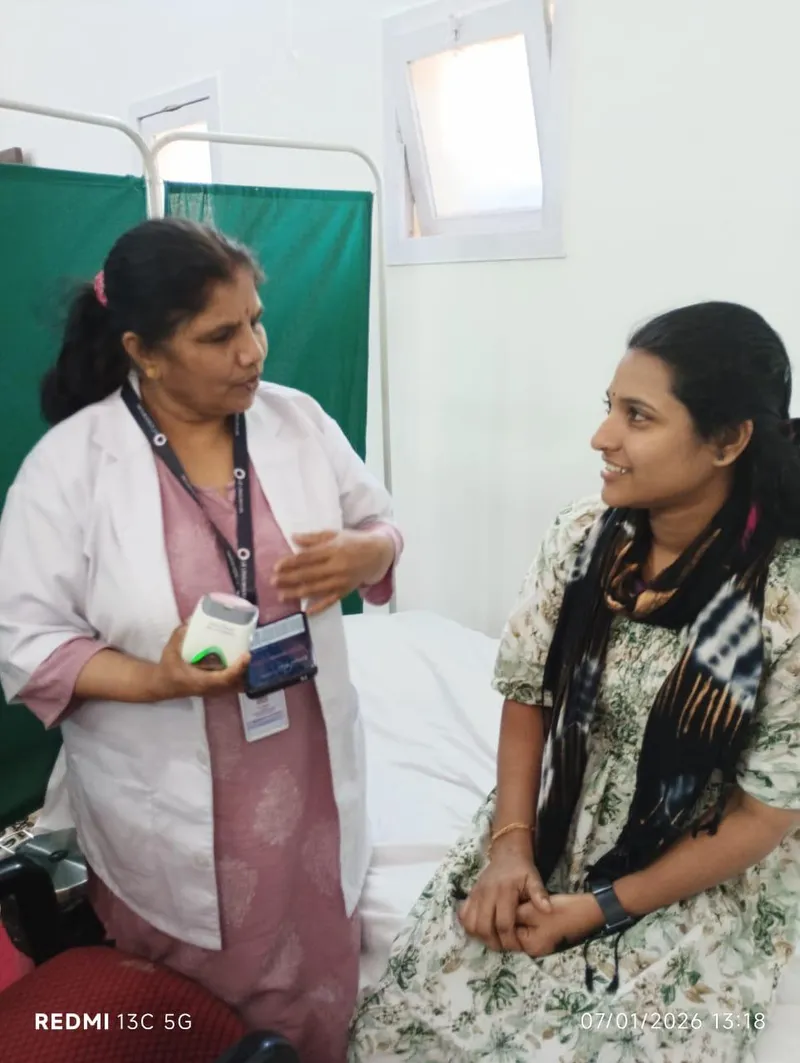
The operator explains how the iBreastExam works
Early detection of breast cancer remains a challenge in India because screening avenues often do not reach the last mile. Also, with radiation involved, younger women, especially those planning a family or who are pregnant, are excluded from mammography. It’s also uncomfortable and scary for many women.
UE LifeSciences’ iBreast Exam is a handheld device that leverages dynamic coplanar capacitive sensing to detect variations in breast tissue elasticity. It identifies areas that are unusually stiff or dense compared to surrounding tissue, flagging them as potentially abnormal.
An embedded AI algorithm then analyses these variations, differentiating between normal tissue patterns and clinically significant stiffness, and highlights regions that may require further evaluation.
iBreast Exam is positioned as a primary screening tool and has been used effectively to screen rural populations. Its programme, rolled out in collaboration with the Goa government, has expanded screening beyond hospitals into rural communities, where preventive care is often limited. The company’s India operations are headquartered in Mumbai.
Niramai Health Analytix
Traditional screening methods are often uncomfortable or inaccessible for many women, especially younger or first-time patients. Bengaluru-based Niramai Health Analytix, founded by Dr Geetha Manjunath, has developed Thermalytix, a tool that uses thermal imaging and machine learning to detect early signs of breast cancer.
The process is radiation-free, requires no physical contact, and can be deployed in a variety of settings, from hospitals to community camps.
The solution is 30% more accurate than traditional methods while costing just 20% as much as existing screening tests. Unlike conventional mammography, which requires expensive equipment and trained technicians, Thermalytix’s thermal imaging approach can be deployed across both rural and urban settings. This screening method has impacted over 2.5 lakh women in 22 countries.
Canfem
Despite growing awareness of breast cancer in India, late-stage diagnosis remains common among underserved populations. Post-surgery and treatment, rehabilitation also remains a significant gap. Canfem, a social enterprise founded by Akriti Gupta, addresses this need by providing affordable breast prostheses and mastectomy bras for breast cancer patients and survivors.
Despite growing awareness, late-stage diagnosis remains a persistent issue—particularly among underserved populations. Faridabad-based Canfem is working to close this gap by focusing on both education and access.
The product’s technology and service models have been approved by leading cancer institutions, including the All India Institute of Medical Sciences and the Tata Memorial Hospital, and have supported over 30,000 cancer survivors across India.
The organisation also offers peer support through an integrated platform, bringing survivors on board and training them as peer counsellors to guide others through their recovery journey.
OncoStem Diagnostics
As breast cancer care evolves, the focus is shifting from one-size-fits-all treatment to personalised medicine. Bengaluru-based OncoStem Diagnostics, started by IISc scientist Manjiri Bakre, has developed CanAssistBreast, a test that evaluates the risk of cancer recurrence by analysing tumour biology.
The test analyses a panel of protein biomarkers from a patient’s tumour sample and integrates this data with clinical factors such as tumour size, grade, and lymph node involvement. Using an AI-driven algorithm, it generates a risk score ranging from 1 to 100 that classifies patients as low or high risk for cancer recurrence over a five-year period.
This enables oncologists to make more informed decisions, particularly regarding the need for chemotherapy, thereby reducing both overtreatment and undertreatment. So far, it has been prescribed by over 800 oncologists and used on more than 10,000 patients across India.
Saaisha India Foundation

The road to recovery for a breast cancer survivor is not easy. After diagnosis, treatment and care, recovery brings another set of challenges—dignity and comfort.
Saaisha India Foundation, a volunteer-led non-profit based in Mumbai, founded by Jayashree Ratan, began with four women coming together to make knitted knockers—soft breast prostheses. It has since grown into a network of over 400 women volunteers across multiple Indian cities and overseas communities, particularly in the Middle East, with its work spreading through beneficiaries, hospitals, and volunteers.
Today, under Saaisha, around 150 volunteers are actively engaged in making prostheses at any given time. Collectively, they have supported over 14,000 women, distributing nearly 28,000 knitted prostheses along with thousands of caps for children undergoing cancer treatment.
Edited by Swetha Kannan